
How Gen Z Is Transforming Flexible Workspaces Today
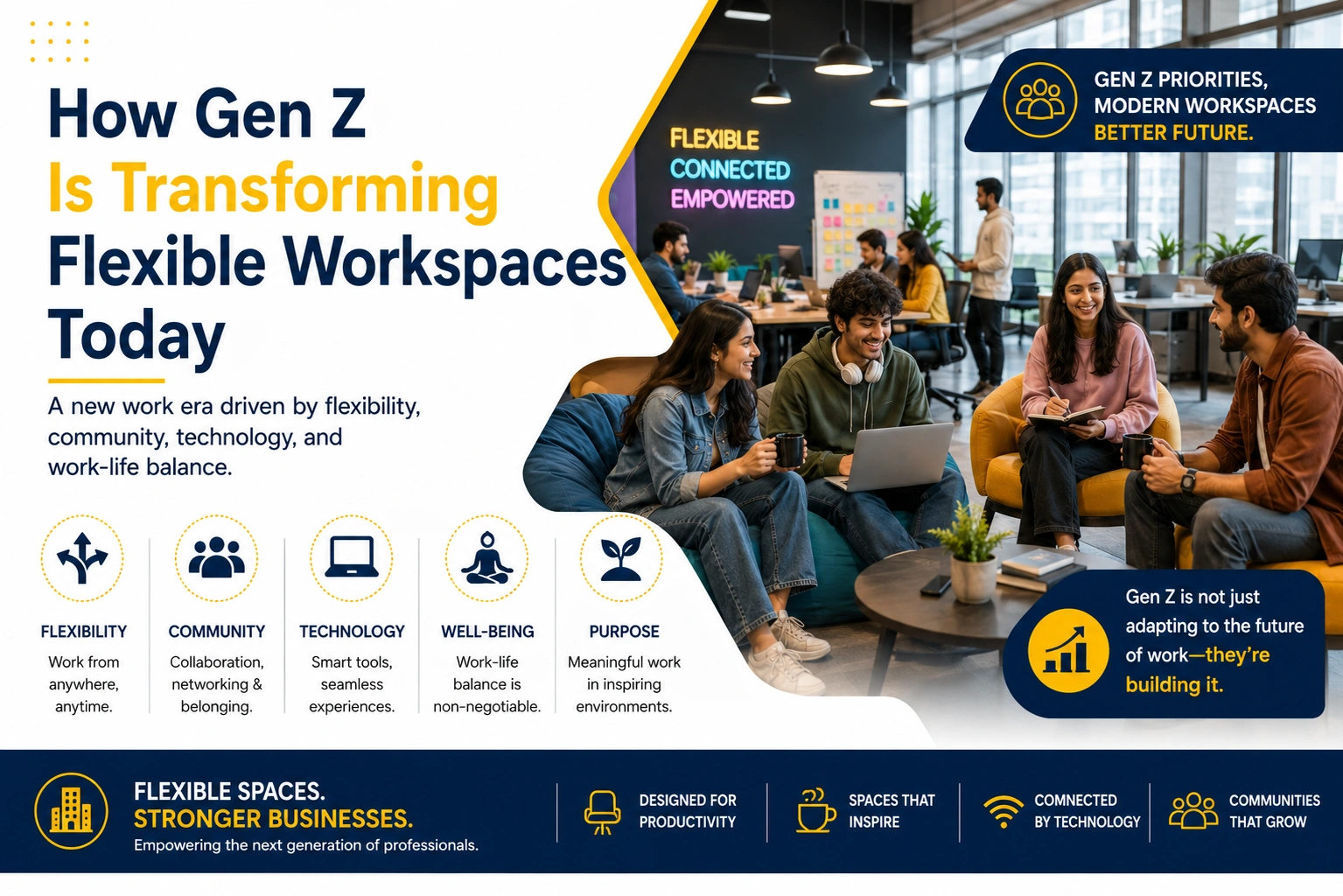
There was a time when work was defined by location. A fixed office, a fixed desk, and a fixed routine shaped how organizations operated and how individuals performed.
That definition no longer applies.
Today, work is fluid. It moves across locations, devices, and time zones. It adapts to people rather than forcing people to adapt to it. And at the center of this shift is a generation that has never experienced rigidity as the default, which is Gen Z.
As Gen Z steadily becomes a larger part of the global workforce, it is not quietly stepping into existing systems. It is questioning them. Redefining them. In many cases, replacing them altogether.
This transformation is not limited to culture or policy. It is deeply influencing the very foundation of workplace infrastructure, such as how workspaces are designed, delivered, and experienced.
At the heart of this evolution are flexible workspaces. Once positioned as alternatives, they are now becoming foundational to how modern organizations think about space, productivity, and growth.
What is changing is not just where people work. It is what they expect work to feel like.
What Are Flexible Workspaces?
Before diving deeper into the transformation, it’s important to establish clarity, not as a definition, but as a shift in mindset.
Flexible workspaces are adaptive office environments that allow businesses to scale, customize, and access workspaces on demand, without long-term commitments.
But their true significance lies beyond flexibility.
They represent a transition from ownership to access, from permanence to adaptability. Instead of locking into infrastructure, organizations can now align workspace with strategy in real time.
These solutions typically include:
- Coworking and shared offices
- Managed and serviced environments
- Hybrid workspace models
- On-demand desks and private suites
- Digitally enabled booking and access systems
In essence, flexible workspace solutions are not just about saving space or cost; they are about enabling responsiveness in a business environment that no longer stands still.
A Market Already in Motion
The shift toward flexibility is not speculative, but it is already underway.
According to CBRE, a significant share of occupiers in India are actively planning to incorporate flexible office formats into their portfolios, signaling a move toward more agile real estate strategies. 65% of office occupiers in India plan to adopt flexible workspace solutions by 2027, reflecting a clear move toward hybrid and agile workplace strategies.
At the same time, India’s flexible workspace stock has crossed 100 million sq. ft., nearly tripling since 2020, signaling rapid institutional adoption of flexible formats.
Insights from JLL further highlight that flexible space operators now account for a significant share of overall office leasing activity, reinforcing their role as a core component of the commercial real estate ecosystem.
These are not incremental changes. They signal a fundamental shift in how workspace is accessed, utilized, and valued.
Flexibility is no longer a parallel model. It is becoming the dominant one.
Gen Z: A Workforce That Thinks Differently
To understand why this shift is accelerating, you have to look beyond infrastructure and into mindset.
Gen Z has grown up in a world defined by immediacy, choice, and personalization. Whether it is content, communication, or commerce, everything adapts to them.
Naturally, they expect work environments to reflect the same flexibility.
They are not drawn to rigid structures or predefined systems. Instead, they gravitate toward environments that offer:
- Autonomy in how work is structured
- Flexibility in where work happens
- Purpose in what they contribute
This is where the concept of employee centric workspaces becomes critical.
According to Deloitte, Gen Z professionals increasingly prioritize work-life balance, purpose, and well-being when choosing employers.
For Gen Z, the workspace is not just a place of output. It is an extension of identity, lifestyle, and community. It needs to support not just productivity, but also well-being, interaction, and personal expression.
Work, in their world, is not separate from life. It is integrated into it.
From Utility to Experience: The Rise of Modern Workspaces
Traditional offices were built for efficiency. Modern ones are built for engagement.
This distinction defines the evolution of modern workspaces.
Today’s environments are no longer static layouts of desks and meeting rooms. They are dynamic ecosystems that adapt to different modes of work — collaboration, focus, creativity, and rest.
You see this transformation in:
- Open, fluid layouts that encourage movement
- Quiet zones that support deep work
- Social spaces that enable informal interaction
- Design elements that create a sense of identity
In modern coworking spaces, this philosophy is taken further. The workspace becomes more than infrastructure. It becomes an experience layer.
People don’t just work there. They engage, connect, and belong.
The value of a workspace is no longer measured in square feet, but in the experience it delivers.
Why Flexible Workspaces Feel Natural to Gen Z
For earlier generations, flexibility was seen as an advantage.
For Gen Z, it is simply expected.
They are accustomed to environments that adapt to them. So when it comes to work, they expect:
- The ability to choose their workspace
- The flexibility to change it when needed
- The freedom to scale usage up or down
This is where flexible offices align seamlessly with their expectations.
Research from Microsoft highlights that flexible and hybrid work models are now a long-term expectation for a majority of employees.
Through a range of flexible workplace solutions, individuals and organizations can access space in ways that match their workflows, whether that means working from a collaborative hub one day or a focused private cabin the next.
This level of adaptability is not just convenient. It is essential in a world where work itself is constantly evolving.
The Quiet Decline of Long-Term Office Models
One of the most significant outcomes of this shift is the gradual decline of long-term leases as the default option.
Flexible office spaces are replacing rigidity with responsiveness.
Instead of committing to space for years, organizations are choosing models that allow them to evolve alongside their business needs.
This is particularly important in a landscape defined by:
- Rapid scaling
- Uncertain demand cycles
- Distributed teams
This shift is being driven not just by startups, but increasingly by large enterprises seeking agility in an unpredictable business environment. Even large enterprises are rethinking their real estate strategies, moving away from fixed commitments toward more agile, hybrid models.
Flexibility, in this context, is not about convenience. It is about control.
Traditional Offices vs Flexible Offices
| Aspect | Traditional Offices | Flexible Offices |
| Lease Model | Long-term, fixed | On-demand, scalable |
| Cost Structure | High upfront investment | Pay-as-you-use |
| Flexibility | Limited | High adaptability |
| Design | Standardized | Experience-driven |
| Technology | Basic | Integrated, seamless |
| Scalability | Slow and complex | Fast and responsive |
| User Experience | Functional | Employee centric workspaces |
This comparison highlights a deeper reality: This shift reflects a deeper transformation in how organizations approach workplace strategy.
Why Companies Are Investing in Flexible Workspace Solutions
While Gen Z may be accelerating the shift, the adoption of flexible workplaces is equally driven by strong business fundamentals.
Organizations today operate in environments defined by uncertainty and speed. In such a context, fixed infrastructure often becomes a constraint rather than an asset.
Flexible models, on the other hand, introduce a new level of strategic agility.
From a financial standpoint, they reduce the need for heavy upfront capital expenditure. Instead of investing in long-term leases, fit-outs, and maintenance, companies can shift toward a more predictable, operational cost structure.
From an operational perspective, flexible workspace solutions enable faster expansion into new markets. Businesses can establish a presence in multiple locations without the delays associated with traditional office setups.
According to CBRE, organizations are actively increasing their adoption of flexible office formats to improve cost efficiency and operational agility.
There is also a direct link to talent strategy.
As organizations compete to attract and retain Gen Z talent, the quality of workspace experience becomes a differentiator. Environments that offer flexibility, design, and community are far more aligned with what the modern workforce expects.
Finally, there is resilience.
In a world where business conditions can shift rapidly, the ability to scale space up or down without disruption is invaluable. Flexible workplaces provide that buffer.
In many ways, they are not just a workplace solution; they are a risk management strategy.
Designing for a Generation That Expects More
Design has moved from being an aesthetic layer to a strategic driver of performance.
Modern office design for Gen Z reflects a deeper understanding of how people work, interact, and create.
It prioritizes:
- Spatial flexibility over rigid layouts
- Visual appeal alongside functionality
- Environments that support both collaboration and focus
But beyond these elements, design today is about creating a sense of connection.
Lighting, materials, textures, and spatial flow all contribute to shaping how individuals experience a workspace. When done right, design does not just enhance productivity—it enhances engagement.
For Gen Z, this matters.
Because the workspace is not just where work happens. It is where identity is expressed.
Employee Centric Workspaces: Redefining Productivity
The traditional definition of productivity, measured in hours and presence, is no longer sufficient.
Today, performance is closely tied to experience.
Research from Gallup shows that employee engagement is closely linked to higher productivity, well-being, and retention.
Employee centric workspaces recognize that people perform better when they have:
- Control over their environment
- Access to multiple ways of working
- Spaces that support wellbeing and comfort
This shift is subtle but powerful.
It moves the focus from managing employees to enabling them.
And in doing so, it creates environments where productivity is not enforced; it emerges naturally.
Technology as the Invisible Enabler
While design shapes the visible experience, technology ensures that everything functions seamlessly.
The most effective flexible workplace solutions are those where technology fades into the background and quietly enables:
- Seamless booking systems
- Effortless access control
- Integrated hybrid collaboration
This layer of technology removes friction from the workplace experience.
It allows users to move, adapt, and work without interruption.
In a flexible environment, this is not optional. It is essential.
Community: The New Core of Workspaces
Perhaps the most defining aspect of modern coworking spaces is the emphasis on community.
Work is no longer isolated. It is collaborative, interconnected, and often spontaneous.
Shared workspaces today function as ecosystems where:
- Professionals from different industries interact
- Ideas are exchanged informally
- Opportunities emerge organically
This sense of belonging is increasingly important, especially for a generation that values connection as much as autonomy.
Community is no longer an add-on. It is the core offering.
Sprint Coworks: Built for the Way Work Is Evolving
As workplace expectations continue to evolve, the need for solutions that can keep pace becomes critical.
Sprint Coworks addresses this need by aligning its offerings with how modern work actually happens.
Its approach is rooted in flexibility, design, and technology:
- Scalable flexible office solutions that adapt to changing business needs
- Experience-driven modern workspaces that balance functionality with engagement
- Fully managed flexible office spaces that simplify operations
- Thoughtfully designed employee centric workspaces that enhance wellbeing and productivity
- Tech-enabled infrastructure that supports hybrid work seamlessly
What differentiates Sprint Coworks is not just what it offers, but how it approaches the concept of workspace itself.
It recognizes that space is no longer static. It is dynamic, evolving, and deeply connected to how people perform.
The Future Is Already Taking Shape
The evolution of workspaces is not something that will happen in the future. It is already happening.
As Gen Z continues to influence workplace expectations, flexible workspace solutions will become:
- More personalized
- More responsive
- More deeply integrated with technology and experience
The organizations that recognize this shift early will not just adapt. They will lead.
Conclusion: This Is Not a Trend
It is easy to describe the rise of flexible workplaces as a trend.
But trends fade. Structural shifts endure.
What we are witnessing is a transition, a structural evolution.
from fixed to flexible, from standardized to personalized, from functional to experiential.
Gen Z is not just participating in this transition. They are driving it.
And in doing so, they are redefining what workspaces need to be.
Flexible workspaces that evolve with this shift will not just remain relevant; they will define what comes next.
FAQs
1. Why are flexible workspaces becoming popular among Gen Z?
Flexible offices align closely with Gen Z’s expectations of autonomy, adaptability, and experience. Unlike traditional offices, they allow individuals to choose how and where they work, offering a mix of collaboration, privacy, and flexibility. For a generation that values work-life integration and purpose-driven environments, flexible workplaces offer a more natural, engaging way to work.
2. What are flexible workplace solutions and how do they work?
Flexible workplace solutions are fully managed office environments that allow businesses to access workspaces on demand without long-term commitments. These include coworking spaces, managed offices, and hybrid workspace models. Companies can scale their space requirements up or down based on team size and business needs, while the workspace provider manages infrastructure, technology, and operations.
3. How are modern workspaces different from traditional offices?
Modern workspaces are designed around user experience, flexibility, and technology integration. They offer dynamic layouts, collaborative zones, and tech-enabled infrastructure. In contrast, traditional offices are typically fixed, lease-driven environments with standardized layouts and limited adaptability. The shift reflects a move from function-driven spaces to experience-driven environments.
4. Are flexible office spaces cost-effective for businesses?
Yes, flexible office spaces are often more cost-effective than traditional offices. They eliminate the need for large upfront investments in leasing, design, and maintenance. Instead, businesses operate on a pay-as-you-use model, allowing for better cost control, scalability, and reduced financial risk, especially in uncertain or rapidly changing markets.
5. What are employee centric workspaces and why are they important?
Employee centric workspaces are designed to prioritize the needs, comfort, and well-being of employees. They offer flexible layouts, ergonomic design, and multiple work settings that support different work styles. These environments are important because they enhance engagement, productivity, and retention by fostering a more supportive, adaptable workplace experience.
6. How do flexible workplace solutions support hybrid work models?
Flexible workplace solutions are inherently designed to support hybrid work by providing on-demand access to office infrastructure across multiple locations. Employees can work from different spaces based on convenience, collaboration needs, or proximity, while organizations maintain operational consistency without managing multiple fixed offices.
7. What makes Sprint Coworks a strong choice for modern businesses?
Sprint Coworks offers a combination of flexible workspace solutions, design-led environments, and technology-enabled infrastructure tailored to evolving workforce needs. Its focus on scalability, employee-centric design, and operational efficiency makes it particularly relevant for organizations looking to create engaging and adaptable work environments for Gen Z and hybrid teams.
Sources
- CBRE Survey: We’re Heading Toward an Era of Adaptive Offices
- CBRE-FICCI Report on Flexible Workplace Solutions
- CBRE: India’s flex office stock
- JLL: India’s office market scales unprecedented highs
- Deloitte 2025 Gen Z and Millennial Survey
- Microsoft Work Trend Index
- Gallup Report: State of the Global Workplace 2026