
Why Managed Office Spaces Are Essential for MNC Expansion in India
Introduction
India is no longer just a back-office destination. For multinational corporations expanding their global footprint, it has become a primary strategic hub, and the demand for managed office spaces is at the center of this transformation.
MNCs entering or scaling within India face a specific set of challenges: tight timelines, unfamiliar real estate markets, compliance complexity, and the need to attract top talent from day one. Managed office setups are built to solve exactly these problems, which are combining professional infrastructure, operational support, and flexibility in one ready-to-deploy package.
This article breaks down how fully managed workspaces are meeting the evolving needs of MNCs across India’s key business cities, and what to look for when choosing the right corporate workspace solution.
The MNC Expansion Story in India
India’s commercial real estate market is experiencing a defining moment. According to Cushman & Wakefield, India’s office sector closed 2024 with a record-breaking 89 million square feet of gross leasing volume across the top 8 cities, which is a historic achievement that cements India’s position as the strongest growth market globally for office space demand.
A significant portion of that demand is being driven by multinationals. Global Capability Centers accounted for approximately 27–29% of the overall demand for office space in 2024, reinforcing India’s strategic importance for global multinationals.
India’s Global Capability Center (GCC) landscape in 2024 includes about 1,700 centers and more than 1.9 million workers. Projections for 2030 anticipate a rise to 2,100–2,200 GCCs employing between 2.5 and 2.8 million people.
This wave of corporate expansion is not happening through traditional long-term leases. MNCs today require speed, flexibility, and operational certainty, and that is exactly what managed offices for MNCs are engineered to deliver.
What Makes Managed Office Spaces Ideal for MNCs
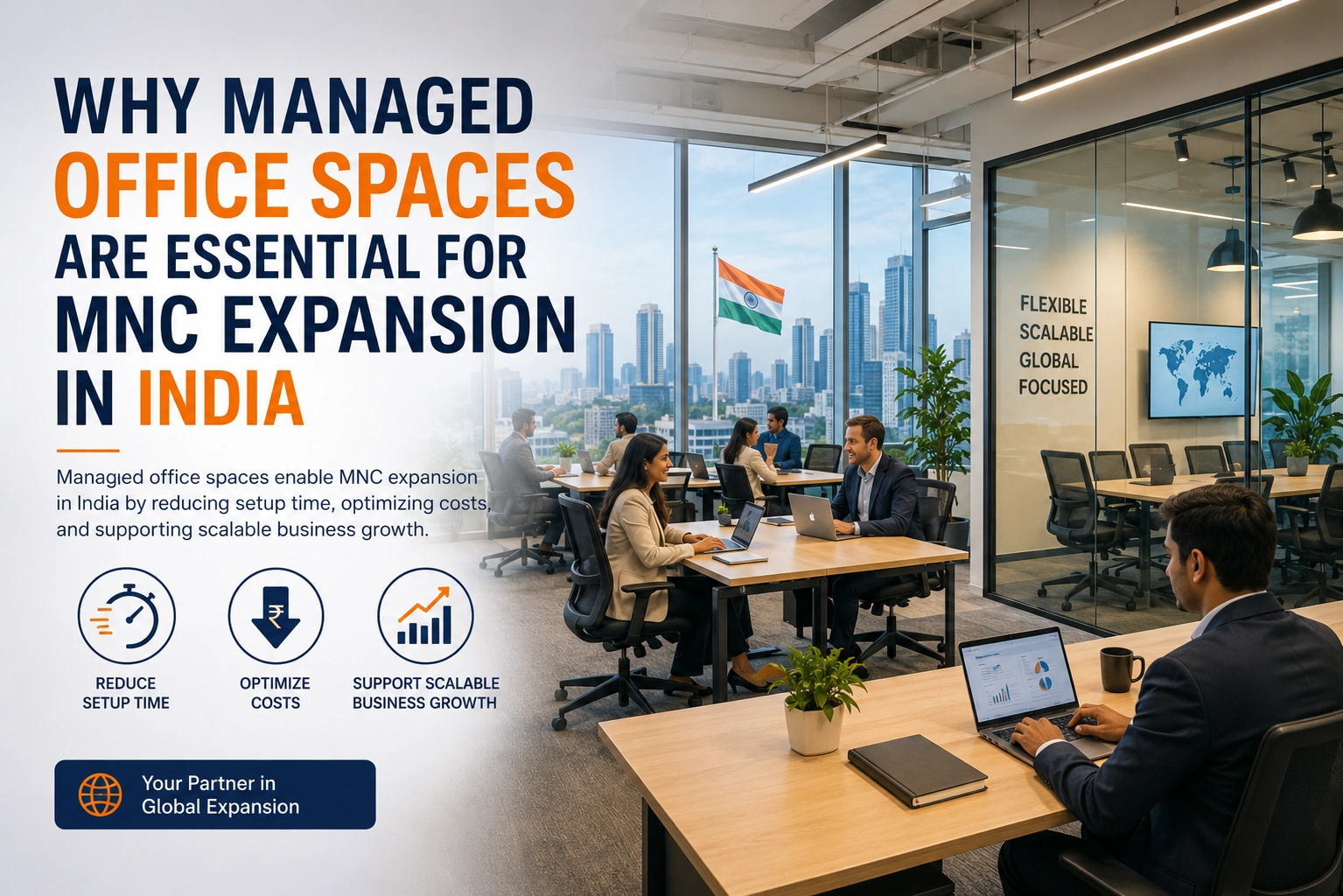
Managed office setups are essential for MNCs expanding in India because they provide fully operational, scalable, and compliant workspaces without the delays and capital investment of traditional offices. They enable faster market entry, flexible growth, and enterprise-grade infrastructure from day one.
When you look at it, a managed office space is not simply a serviced desk or a coworking seat. It is a fully operational, private workspace that a third-party provider designs, builds, and manages on behalf of the occupying company.
The distinction matters. Unlike generic coworking spaces, where teams share open-plan floors with strangers, fully managed office spaces give companies:
- A dedicated, private environment aligned with their brand identity
- End-to-end facility management is handled by the provider
- Enterprise-grade IT infrastructure, security, and compliance built in
- Flexibility to scale without renegotiating from scratch
Enterprises can achieve significant savings by choosing flexible or managed office models compared to traditional leasing, with savings coming from avoided fit-out costs, bulk rentals, and high operational expenditure.
For an MNC entering India for the first time, or expanding an existing GCC, those savings combined with the speed of deployment make managed offices the logical starting point.
Key Ways Managed Offices Serve MNC Needs
MNCs operate differently from startups or SMEs. Their requirements are more complex, their compliance obligations more stringent, and their employee experience expectations higher. Here is how managed offices for MNCs address each of those needs.
Eliminating the Setup Complexity
Setting up a conventional office in India involves multiple moving parts: scouting real estate, negotiating leases, hiring contractors, sourcing vendors, procuring IT hardware, and navigating local building compliance. For a foreign company unfamiliar with India’s property landscape, this process can take months.
Managed offices compress that timeline dramatically. A fully serviced office can be ready for a team to occupy in just a few weeks, whereas a traditional office setup often requires months or even years to complete.
Converting CAPEX to OPEX
One of the clearest financial advantages of fully managed office space for MNCs is the shift from capital expenditure to operational expenditure. Instead of committing large sums upfront to fit-outs, furniture, IT infrastructure, and equipment, companies pay a predictable monthly fee that covers everything.
Operational cost savings from opting for managed office models vary between 20–30%, depending on the duration of operations, size of setup, and services provided.
This model lets multinationals preserve capital for core business operations and avoid the financial risk that comes with long-term property commitments in an unfamiliar market.
Plug and Play Office Spaces: Speed to Market
For MNCs, time is directly tied to revenue. Every week spent setting up an office is a week of delayed hiring, delayed project delivery, and delayed market capture.
Plug and play office spaces solve this with ready-to-occupy infrastructure that requires zero setup time on the occupier’s part. Managed offices come with plug-and-play facilities such as high-speed internet, ergonomic furniture, meeting rooms, and enterprise-grade security systems, enabling companies to become operational swiftly.
This is particularly valuable for GCCs and MNCs that need to hire and onboard large teams quickly. A workspace that is already fully equipped with the right network infrastructure, collaboration zones, and support staff, which means new employees can walk in and start contributing from day one.
The operational advantages of plug-and-play setups for MNCs include:
- Immediate occupancy — no fit-out delays, no contractor coordination
- Bundled services — IT support, housekeeping, power backup, pantry, and security included
- Predictable costs — one monthly invoice rather than managing multiple vendor relationships
- Professional presentation — enterprise-grade facilities that reflect global brand standards from day one
Scalability Without the Lease Burden
One of the most critical requirements for any MNC in India is the ability to scale. GCCs frequently start with a small founding team and grow rapidly as they hire local talent and expand operational mandates.
Traditional office leases are structurally incompatible with that kind of growth. A long-term lease for 100 seats signed in year one becomes a constraint when the team reaches 300 in year two or a costly liability if growth slows.
Corporate workspace solutions built on a managed model eliminate this problem. A global company can start with 20 desks in a managed workspace and scale up to 200 within the same network, testing market potential without long-term commitments.
The scalability runs in both directions. MNCs that encounter a market slowdown, go through a restructuring, or shift to a hybrid model can reduce their footprint without the financial penalty of breaking a conventional lease.
Enterprise clients accounted for 54.1% of India’s flexible office market in 2024, according to Mordor Intelligence, a clear signal that large corporations, not just startups, have embraced the managed model as their preferred operational structure.
Premium Managed Offices and Brand-Aligned Workspaces
MNCs do not just need a functional office; they need one that reflects their global brand and meets the expectations of the talent they are competing to attract. Premium managed offices in India are now built with precisely this in mind.
Modern managed office providers offer significant customization capabilities, allowing MNCs to shape their workspace around their own culture, aesthetics, and functional requirements. This typically includes:
- Brand integration — logo placement, corporate color schemes, zonal signage
- Custom layouts — R&D labs, trading floors, secure data pods, collaboration zones
- Wellness design — biophilic elements, acoustic treatment, ergonomic specifications
- Hospitality-level amenities — premium breakout areas, cafeterias, recreation zones
MNCs increasingly prefer managed offices with hybrid layouts, sustainability features, and smart technology integration with employee wellness zones and enterprise-ready security solutions emerging as defining priorities.
Employee experience has become a talent retention tool, particularly for GCCs competing with domestic tech giants for the same skilled workforce. A thoughtfully designed, well-managed office signals to employees that the company values their environment and that message matters in hiring conversations.
Compliance, Security, and ESG Alignment
For multinationals, regulatory compliance and data security are non-negotiable. Operating in a country with a complex legal and regulatory framework — spanning labour law, IT infrastructure requirements, data protection norms, and building safety codes — requires specialist knowledge that most MNCs do not carry in-house.
The best-managed offices in India build compliance into their offering. This includes:
- Data security — enterprise-grade network infrastructure, access control, server room provision
- Regulatory alignment — spaces structured to meet applicable Indian legal and building code requirements
- ESG compliance — green building certifications, energy-efficient design, waste management protocols aligned with global corporate sustainability mandates
In Q1 2025, approximately 80% of leased office space in India was in certified green buildings, a share expected to rise amid tightening regulations. Green buildings were projected to add 1 billion square feet by the end of that year, with smart technologies such as motion-sensor hot-desking and VR/AR amenities enhancing their appeal and supporting occupiers’ ESG goals.
For MNCs with global sustainability targets, choosing a workspace partner that operates certified green buildings is not just a preference, but it is increasingly a board-level requirement.
The Role of Location in Corporate Workspace Strategy
Where a managed office is located directly affects talent access, client accessibility, and brand perception. The best managed offices for MNCs are embedded in India’s established commercial corridors, which are the zones where enterprise infrastructure, transport networks, and talent pipelines converge.
India’s key managed office markets include:
- Bengaluru — accounts for 34% of GCC leasing activity, home to India’s deepest technology talent pool
- Hyderabad — office absorption hit 4 million square feet in Q1 2025 alone, driven by tech giants and Global Capability Centers
- Delhi-NCR — recorded its highest quarterly leasing volume in over two years in Q1 2025, with a 32% rise in absorption
- Mumbai (BKC) — premier financial district, preferred by BFSI-sector MNCs
- Pune and Chennai — strong engineering and manufacturing talent bases, growing GCC presence
For MNCs evaluating a managed office space provider, multi-city presence is a key selection criterion. A provider with locations across these markets enables MNCs to deploy consistent workspace standards as they expand to new cities without starting the search process from scratch in each location.
Sprint Coworks: Enterprise-Ready Managed Offices in India
For MNCs and growing enterprises that need a workspace built to global standards and without the operational burden of running it themselves, Sprint Coworks delivers a managed office experience designed for serious business.
Sprint Coworks is a premium managed office space provider offering fully serviced, private, and customizable workspaces for companies across India’s key business cities. The focus is squarely on enterprise readiness: every space is built to support large teams, demanding workflows, and the exacting standards that multinationals require from day one.
What Sprint Coworks Offers MNCs
Plug and play corporate infrastructure: Sprint Coworks spaces come fully equipped and immediately operational with enterprise-grade internet, furnished workspaces, meeting rooms, IT support, and facility management are all included. No fit-out delays, no vendor management headaches.
Private, brand-aligned environments: Unlike open coworking floors, Sprint Coworks provides dedicated private spaces that MNCs can align with their brand identity, culture, and functional workflow requirements. Your office looks and feels like yours without the ownership burden.
Scalable from day one: Whether a company is entering India with a 20-person founding team or scaling an established GCC to 300 seats, Sprint Coworks offers membership structures that flex with the business. Growth should not require a new lease negotiation, and at Sprint Coworks, it does not.
Compliance and security built in: Data security, access control, and building safety standards are embedded in the Sprint Coworks operational model, giving MNCs the assurance they need without requiring a dedicated in-house facilities team.
Strategic locations: Sprint Coworks operates in prime commercial locations, ensuring that MNC teams have access to the talent corridors, transport links, and business ecosystems that drive productivity and attract the right people.
For any multinational evaluating its India workspace strategy, Sprint Coworks offers the combination of speed, quality, flexibility, and operational certainty that defines the best-managed office spaces in the market today.
FAQs
- What is a managed office space and how does it differ from a regular coworking space?
A managed office space is a fully serviced, private workspace operated and maintained by a third-party provider. Unlike coworking spaces, where individuals share open-plan areas, the managed offices give companies a dedicated, customizable environment with enterprise-grade infrastructure, their own branding, and complete operational support. They are designed specifically for teams that need privacy, compliance, and control.
- Why are MNCs choosing managed office spaces over traditional leases in India?
Traditional leases require significant upfront capital, months of setup time, and long-term commitments that don’t suit fast-moving corporate expansion. Managed offices eliminate these barriers, offering immediate occupancy, OPEX-based pricing, and the ability to scale up or down without renegotiating a lease. For MNCs entering or expanding in India, this model delivers speed, cost efficiency, and operational certainty simultaneously.
- How do plug-and-play office spaces help MNCs enter the Indian market faster?
Plug-and-play office spaces are fully equipped and ready for immediate occupation with IT infrastructure, furniture, meeting rooms, housekeeping, and security already in place. This allows MNCs to move teams in within days or weeks rather than waiting months for a conventional fit-out to be completed. Faster setup means faster hiring, faster project delivery, and faster returns.
- What cities in India have the strongest demand for managed offices among MNCs?
Bengaluru leads with 34% of GCC leasing activity, followed by Hyderabad, Delhi-NCR, Mumbai, Pune, and Chennai. These cities combine deep talent pools, strong commercial infrastructure, and established business ecosystems, which are making them the primary targets for MNC expansion in India.
- How much can MNCs save by choosing managed office setups over traditional leases?
Reports from Knight Frank and CBRE indicate savings of 15–45% compared to traditional leasing, depending on team size, location, and lease duration. Savings come primarily from eliminated fit-out costs, avoided CAPEX on equipment and furniture, and the consolidation of multiple vendor relationships into a single managed service fee.
- How do managed offices support ESG and sustainability goals for MNCs?
Leading managed office providers in India operate in green-certified buildings with energy-efficient lighting, waste management protocols, and sustainable design. For MNCs with global ESG commitments, choosing a workspace partner that meets these standards allows them to align Indian operations with corporate sustainability targets without investing in proprietary fit-outs.
- What should MNCs look for when evaluating a managed office space provider in India?
Key criteria include multi-city presence, the quality and certifications of the buildings they operate in, customization flexibility, compliance and data security standards, lease flexibility, and the depth of the services included in the management fee. A provider with enterprise-focused experience and a proven track record with large corporate clients is typically the strongest foundation for a successful workspace partnership.
- Does Sprint Coworks offer private managed offices for MNC teams?
Yes. Sprint Coworks provides fully private, brand-aligned managed office environments specifically designed for enterprise clients and MNCs. These are not shared coworking floors, but they are dedicated spaces built to the team’s size, workflow, and brand requirements, with complete operational management handled by Sprint Coworks.
- Can MNCs scale their workspace at Sprint Coworks as their India team grows?
Absolutely. Sprint Coworks’ managed office model is built around scalability. Companies can start with a focused founding team and expand their footprint within the Sprint Coworks network as hiring ramps up without the disruption of searching for new real estate or negotiating a new lease from scratch.
Conclusion
India’s position as a global corporate hub is no longer in question. The data from Cushman & Wakefield, CBRE, and Mordor Intelligence all point in the same direction: MNCs are expanding aggressively, GCCs are multiplying, and the demand for high-quality managed office space is growing with them.
The traditional office lease model, which is slow, capital-intensive & inflexible, is structurally misaligned with how MNCs actually need to operate in a dynamic market like India. Fully managed office spaces have stepped into that gap, offering enterprise-grade environments that can be occupied within weeks, scaled without penalty, and customized to reflect a company’s global brand standards.
For a multinational building its India presence, the workspace decision is not a secondary consideration. It affects how fast you hire, how well you retain, how compliantly you operate, and how confidently you present to clients and partners.
The right managed office space provider doesn’t just give you a desk and a postcode, but it gives you the operational foundation to build something significant. Choose accordingly.
Ready to explore enterprise-grade managed office setups in India? Discover what Sprint Coworks offers for MNCs, GCCs, and growing corporate teams.
Sources:
- Cushman & Wakefield – India’s Office Sector Historic Leasing in 2024
- India GCC Landscape Report by Nasscom
- Knight Frank’s Report on the expanding role of flexible workspaces
- JLL Insights on India’s evolving flexible workspace market
- Mordor Intelligence India Flexible Office Space Market Size & Share Analysis
- 2025 CRE Sustainability Report by Altre
- Archive Market Research
- Managed Office Space Market Size India 2025–2030 by Mddir
- Role of GCCs in India’s Rising Managed Office Space Demand by Brigade Group