
The Flexible Workspace Model: The Future of Human-Centric Offices
Introduction
The office is not disappearing. It is transforming. The flexible workspace model has moved from a fringe idea to the dominant framework shaping how companies design, lease, and think about their physical work environments.
At the heart of this shift is a deceptively simple insight: offices should adapt to people, not the other way around. This is the premise of what is increasingly being called the human-liquid workspace, a human-centric workplace model where space is fluid, purposeful, and built around the actual rhythms of how modern teams work.
This article unpacks what that model looks like in practice, why it is gaining momentum globally, and how businesses can use it as a strategic advantage.
From Fixed Floors to Fluid Spaces: The Shift in Office Thinking
For most of the twentieth century, office design followed a single principle: assign a person a desk, and that desk belongs to them. Hierarchy was expressed in floor plans. Seniority was measured in square footage. The office was a fixed institution.
That model is now structurally obsolete.
The pandemic did not create flexibility; it accelerated a transition that was already underway. Remote work, digital collaboration tools, and a generation of employees who had grown up working from anywhere forced companies to confront an uncomfortable truth: most of their office space was being used inefficiently, and much of it was not serving the people who sat in it.
The development of modern work environments increasingly reveals a change in perspective. It is moving away from fixed structures and toward adaptability, from owning resources to sharing them, and from simply being present in person to embracing overall well-being and experience.
The question companies are now asking is not “how many desks do we need?” but “what does our office actually need to do?” That reframing is what gives rise to the flexible, adaptive and human-centric workspace model.
What Is a Flexible Workspace Model?
A flexible workspace model is an approach to office design and real estate where space adapts to the needs of the people using it, rather than locking employees into fixed desks or long-term leases.
It combines activity-based zones, scalable membership options, and on-demand access, giving businesses the freedom to grow, shrink, or shift without the constraints of a traditional office setup.
Core Principles of the Flexible Workspace Model
Understanding the flexible workspace framework requires looking at its structural principles, not just its aesthetic outputs. Here is what defines it:
Activity-Based Working
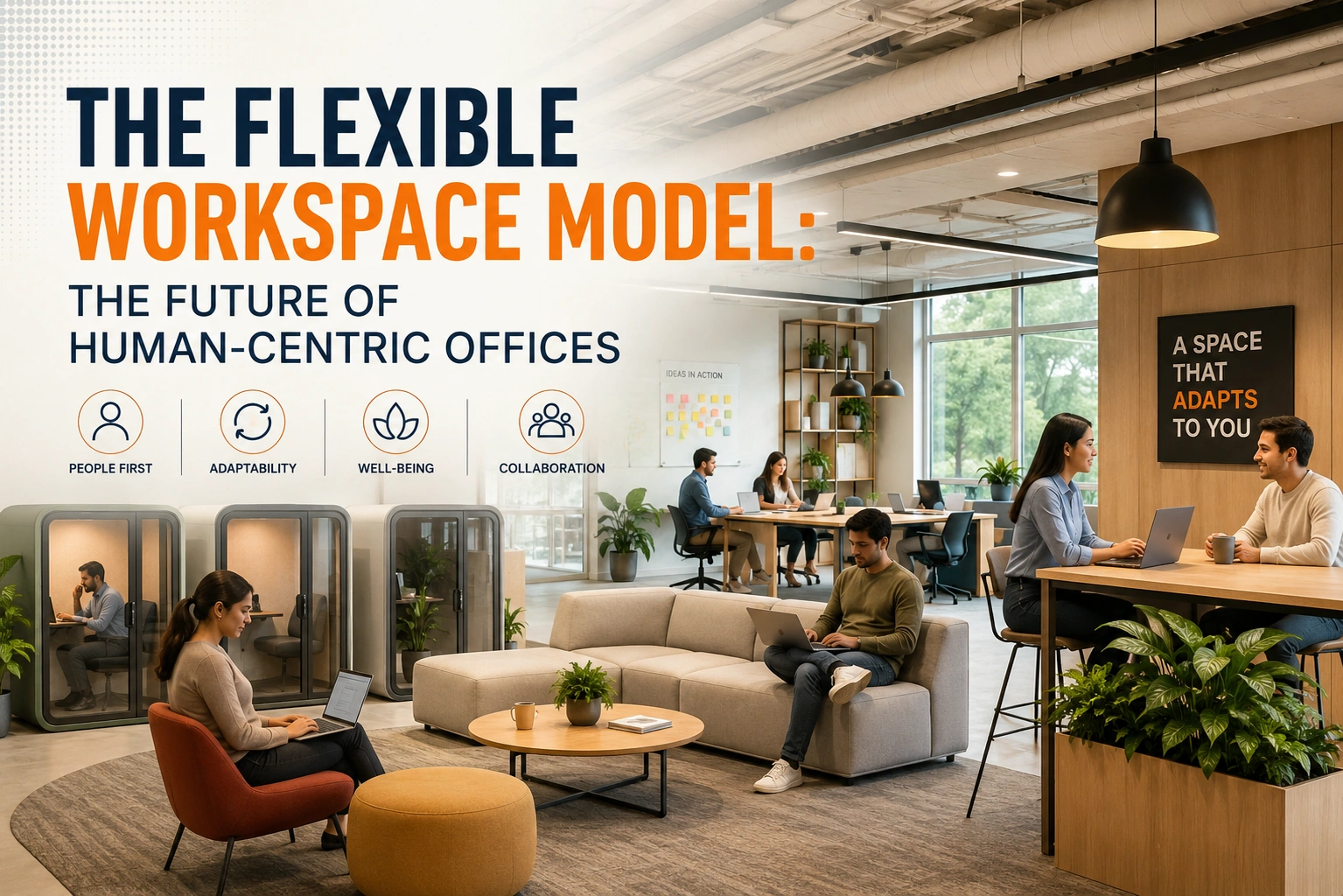
Rather than organizing space around departments or seniority, activity-based working organizes space around tasks. Meeting rooms, focus pods, collaborative zones, lounge areas, and social spaces all serve different cognitive modes. Employees choose their environment based on what they are doing and not where their name tag is.
Right-Sizing Over Surplus
Companies operating a flexible workspace framework do not lease space for their maximum possible headcount. They lease for their typical utilization profile, adding capacity through flexible office solutions like hot-desking, on-demand meeting rooms, and satellite locations when needed. This fundamentally changes the economics of corporate real estate.
Designed for Belonging, Not Just Function
The workplaces of the future, such as Sprint Coworks, prioritize collaboration, adaptability, socializing, focus, and support with spaces that enable seamless transitions between these activities. The best flexible workspaces feel less like offices and more like environments where people genuinely want to spend time.
Modularity and Adaptability
A liquid workspace is never finished. Furniture is reconfigurable. Walls move. Meeting rooms convert to project rooms. The physical environment evolves as team sizes, project demands, and working styles shift without requiring a renovation each time.
The Benefits of Flexible Workspaces for Businesses and People
The benefits of flexible workspaces are well-documented on both sides of the employer-employee relationship.
For businesses:
- Significant reduction in real estate costs, paying for utilized space rather than allocated space
- Faster market entry through plug-and-play infrastructure
- The ability to scale teams up or down without lease renegotiations
- Access to premium locations and facilities without full ownership costs
- Improved talent acquisition in competitive hiring markets
For employees:
- Autonomy over when and how they work is a top-ranked job preference factor globally
- Workspaces that support their cognitive needs throughout the day
- Reduced commute burden through distributed location options
- Better work-life integration without sacrificing professional environment quality
Research shows that 90% of hybrid employees say they are as productive or more productive in their current working style compared to traditional full-time office arrangements.
Nearly three-quarters of employees say their workplace became more attractive to prospective hires because of flexible work policies, making workspace flexibility a direct recruiting advantage.
Workspace Flexibility Trends Defining 2026 and Beyond
The workspace flexibility trends shaping the market right now go well beyond furniture choices. They reflect a deep restructuring of how companies relate to physical space, and in 2026, that restructuring has moved from experimentation to execution.
A Human-Liquid Workspace
A human-liquid workspace is a concept that describes an office environment that flows and adapts to the needs of its occupants. Like a liquid, the space takes the shape required by the people using it, quiet when focus is needed, open when collaboration is the priority, and social when connection matters. It places human experience at the center of every design decision.
A human-liquid workspace model is built on three ideas: space is chosen not assigned, the office earns attendance rather than mandating it, and human needs drive every design decision, treating comfort, acoustics, natural light, and ergonomics as essentials, not extras. According to a 2024 Steelcase report, 72% of employees globally now prioritize well-being and flexibility over private ownership of space.
It has become a defining trend because the traditional fixed-desk office no longer matches how people actually work and businesses that fail to adapt are losing talent to those that do.
The Flight to Quality
The era of leasing more space than you need as a status symbol is over. Companies are making a deliberate trade: less square footage, significantly better quality. According to the Cushman & Wakefield 2025 Global Flexible Office Trends Report, about 55% of occupiers now use flexible office solutions, and 17% plan to increase their usage. This shift is pushing providers to offer modular layouts and plug‑and‑play infrastructure.
The expectation from those occupiers has risen sharply. Premium amenities, hospitality-level service, and thoughtfully designed environments are now baseline requirements and not differentiators. Spaces that offer an average experience are losing ground fast.
The Hybrid Workplace
The hybrid workplace is the operating environment in which the agile workspace model thrives. Hybrid work, where employees split time between remote and in-person settings, is no longer an experiment. It is the dominant mode of professional work.
Roughly two-thirds of leaders say their firms use a hybrid work model, with larger organizations being particularly likely to adopt remote work structures. According to recent Gallup findings, among employees whose jobs can be done remotely, 60% favor a hybrid schedule. Roughly 30% would choose to work entirely from home, while under 10% wish to work exclusively in the office. The hybrid workplace is not just a workforce preference, but has turned into a retention strategy. And the office space that supports it needs to be fundamentally different from what came before.
Biophilic and Wellness-Integrated Design
Employee well-being has shifted from a human resources buzzword to a central element of workplace design. Modern office layouts are increasingly guided by psychological well-being and flexibility, incorporating biophilic design with natural light, plants, and organic materials, as well as wellness zones for relaxation, mindfulness, and quiet recovery. These are not decorative choices.
Research consistently links natural light and green elements to reduced stress, improved focus, and higher job satisfaction. In 2026, the leading office design priorities are biophilic elements, inclusivity, and overall wellness. This, with natural light, indoor greenery, ergonomic furniture, and sound control, is considered an essential feature rather than optional additions.
This evolution is backed by business logic. According to industry experts, a supportive and inspiring physical work environment enhances employee well-being, which in turn drives productivity. As a result, investing in wellness-focused design is increasingly viewed as a strategic business decision rather than an expense.
AI-Powered Space Management
Smart offices have moved from being a trendy addition to a fundamental requirement. In 2026, workplace AI has progressed beyond chat-based assistance to become a seamless part of daily operations, managing meeting summaries, forecasting schedules, and optimizing workspace usage for hybrid teams.
AI-powered personalization and real-time occupancy management can boost revenue by over 50%. With desk-sharing now in place at 61% of flexible offices, the demand for live space data has become even more critical. Workplaces that fail to offer this level of intelligence risk falling structurally behind.
Distributed Work Hubs
The era of the single, large-scale headquarters is giving way to networks of smaller, strategically located offices. Companies are rethinking the expense of maintaining full-time office spaces that often sit half empty, and are instead turning to flexible workspace solutions that can scale and evolve with their needs. According to CBRE, approximately 31% of large enterprises have been investing in flexible spaces to enter new markets, using managed and flexible offices as market-entry vehicles rather than committing to owned real estate.
One of the most notable trends of 2026 is the rise of hyper-local coworking and flexible spaces, situated in suburban areas and residential neighborhoods rather than exclusively in city centers. This shift is driven by employees who want to work close to home without enduring long commutes. For businesses, distributed hubs offer faster market entry, reduced overhead, and a workspace model that adapts alongside the company’s growth.
Technology as the Backbone of the Human-Centric Office
A truly flexible workspace framework cannot function without the right technology layer underneath it. Space without smart management quickly becomes chaotic; people cannot find desks, meeting rooms get double-booked, and utilization data is invisible to decision-makers.
The technology stack supporting the human-centric liquid office typically includes:
- Desk and room booking systems — apps that allow employees to reserve space based on availability and their schedule
- Occupancy sensors — IoT devices that track real-time space utilization, allowing operators to optimize layout and capacity
- Access control and security — digital systems that manage entry, protect sensitive areas, and log usage without friction
- Collaboration infrastructure — seamless video conferencing, wireless presentation systems, and hybrid-ready meeting rooms that serve both in-person and remote participants equally
- Workplace analytics dashboards — data tools that surface how space is being used, when, and by whom — enabling continuous improvement
AI-powered workspace management tools that track occupancy and suggest optimal desk usage are no longer futuristic, and they are the new standard in smart office environments in European countries.
Technology does not replace the human dimension of the office. It enables it by removing friction, reducing wasted time, and letting people focus on the work itself rather than the logistics of finding space to do it.
Managed Office Spaces: The Infrastructure of the Flexible Future
The flexible workspace framework does not operate in a vacuum. It needs physical infrastructure that is built to support it. This is where managed office spaces have become central to how businesses execute their workspace strategy.
A managed office brings together everything the flexible model requires, such as professional design, maintained facilities, enterprise-grade technology, and operational support under a single provider. Companies do not need to build or maintain that infrastructure themselves. They simply occupy a space that already has it.
The global flexible office market was valued at USD 45.24 billion in 2025 and is projected to reach USD 194.75 billion by 2034, growing at a CAGR of 17.95%. That growth is being driven directly by the adoption of the agile and adaptive workspace model across enterprises of all sizes.
For companies implementing a human-centric workspace strategy, managed offices provide:
- Spaces that can be customized to reflect brand identity and culture
- The ability to enter new markets quickly without long-term lease risk
- Facility management handled entirely by the provider
- Access to meeting infrastructure, event spaces, and collaborative zones on demand
- Consistent quality standards across multiple city locations
Sprint Coworks: Built for the Future of Work
The flexible workspace model is not a concept Sprint Coworks has retrofitted onto an existing product. It is the foundation on which Sprint Coworks was built.
Sprint Coworks is a premium managed office space and coworking space provider that has designed its environments around the principles of the human-centric workspace, where spaces that serve people first, adapt to how teams actually work, and give businesses the flexibility they need to grow without the constraints of traditional real estate.
A Workspace That Moves With You
Sprint Coworks offers a range of flexible office solutions, from hot desks and dedicated workstations to fully private managed offices, that scale with your business. Whether you are a solo founder finding your rhythm or a corporate team expanding to a new city, the workspace adapts to you.
Human-Centric by Design
Every Sprint Coworks space is designed with the principles of the human-liquid model in mind: activity zones for focused work, collaboration areas for team sessions, social spaces for the informal interactions that build culture, and wellness-oriented design that makes the office a place people actually want to come to.
Hybrid Workplace Ready
Sprint Coworks environments are built for the hybrid workplace reality and equipped with enterprise-grade video conferencing, smart room booking, high-speed connectivity, and the kind of professional infrastructure that makes hybrid attendance seamless for both in-person and remote team members.
Managed So You Can Focus
The facility management, IT infrastructure, housekeeping, security, and operational support at Sprint Coworks are handled entirely by the Sprint Coworks team. Your business shows up, plugs in, and gets to work, without the overhead of running an office.
For any business that recognizes the future is flexible, Sprint Coworks is the workspace that was built for it.
FAQ
- What is a flexible workspace model?
A flexible office space model is an approach to office design and real estate strategy that prioritizes adaptability over fixed structure. Rather than assigning every employee a permanent desk, flexible workspaces offer a range of environments, focus zones, collaboration areas, meeting rooms, and social spaces that employees use based on their activity. It is built around how people actually work, not how they were historically expected to work.
- How does the hybrid workplace drive demand for flexible workspaces?
Hybrid work means employees are not in the office every day, which makes traditional one-person-one-desk layouts wasteful and expensive. Flexible workspaces solve this by designing for actual utilization patterns, offering shared desks, bookable rooms, and adaptable zones that serve a fluctuating number of occupants efficiently. Hybrid work and flexible workspace design are structurally complementary.
- What are the main benefits of flexible workspaces for companies?
The primary benefits include a significant reduction in real estate costs, the ability to scale headcount without renegotiating leases, faster market entry through plug-and-play infrastructure, improved talent attraction and retention, and access to premium workspace quality without long-term ownership commitments.
- How do managed office spaces support the flexible workspace framework?
Managed office spaces provide the physical and operational infrastructure that makes the flexible workspace framework possible at scale. They handle fit-out, technology, facility management, and compliance by allowing occupying companies to benefit from a fully flexible, professional environment without building or running it themselves.
- What workspace flexibility trends are shaping offices in 2026?
The most significant trends include the widespread adoption of activity-based working, integration of wellness and biophilic design elements, smart technology for space management and occupancy tracking, a flight toward quality over quantity in corporate real estate, and the growth of distributed workspace networks replacing single large headquarters.
- Does Sprint Coworks support hybrid workplace space arrangements?
Yes. Sprint Coworks is designed specifically for the hybrid office reality. All spaces are equipped with enterprise-grade connectivity, video-conferencing infrastructure, and smart booking systems that make hybrid attendance seamless.
- What types of businesses is Sprint Coworks best suited for?
Sprint Coworks is designed to serve a wide range of businesses, from independent professionals and early-stage startups to growing SMEs and enterprise teams establishing a presence in a new city. The flexible membership structure and human-centric design make it a strong fit for any organization that wants a high-quality, professionally managed workspace without the rigidity of a conventional office lease.
Conclusion
The office is not going away. But the version of it that most people grew up working in, rows of assigned desks, long leases, and rigid hierarchies expressed through floor plans, is being replaced by something more intelligent and more human.
The flexible workspace model represents a fundamental rethinking of what office space is for. It starts with people, their cognitive needs, their working rhythms, their desire for autonomy alongside connection and works backward to design environments that genuinely serve them.
The data is clear: 95% of businesses have made their workspaces more flexible recently, and 82% plan to keep making them even more adaptable. This is not a trend that is peaking, but it is a baseline that is still being established.
For businesses navigating this transition, the key is not to chase every new design concept but to commit to a core principle: space should work for the people who use it. When that principle drives every decision about layout, technology, lease structure, and amenity design, the result is an office that earns its place in how people work.
The future of the office is not fixed. It is fluid, human, and flexible by design.
Looking for a workspace that embodies the flexible model — where design, technology, and community come together to support the way you actually work? Explore Sprint Coworks.
Sources:
- Wellbeing Urgency by Steelcase
- Steelcase Global Report on Hybrid Work
- Key Hybrid Work Statistics in 2026
- Gallup Indicators for Hybrid Work
- What Occupiers Want 2025 Survey by Cushman & Wakefield and CoreNet Global
- Flexible Office Market by Fortune Business Insights
- Hybrid Work Statistics
- Flux HQ
- Global Trends In Flexible Office 2025
- Flux HQ