
Why the 4-Day Work Week Is Fuelling India’s Coworking Boom
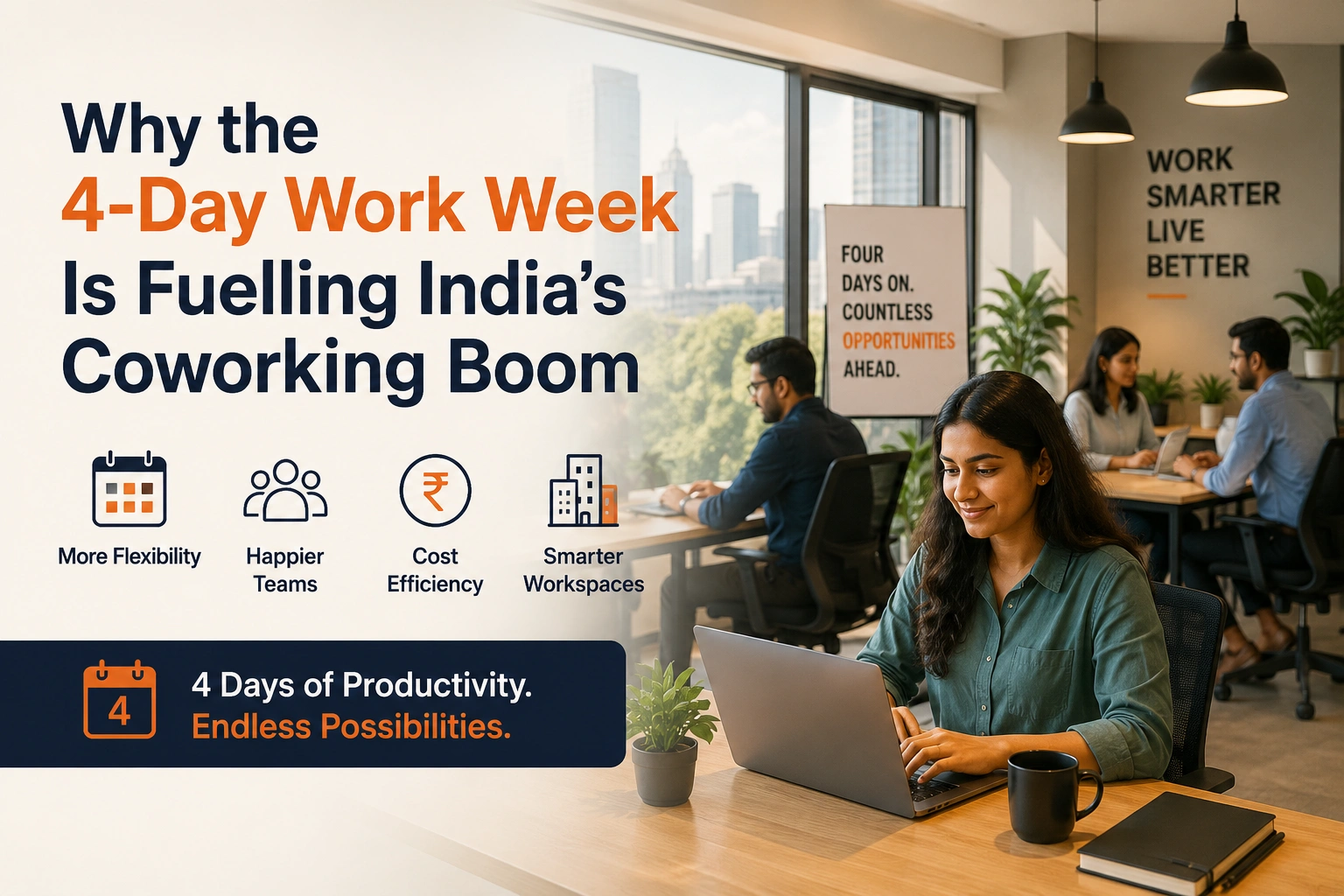
India’s work culture is shifting and shifting fast.
Compressed schedules, outcome-based models, flexible Fridays, the 4-day work week is no longer a headline from a Scandinavian pilot programme. It’s showing up in Indian startups, mid-size enterprises, and even large corporates right now. And as the when and where of work evolves, one industry is quietly winning: coworking spaces.
The data backs it up. According to Crisil Ratings (May 2026), India’s flexible workspace sector has recorded a CAGR of ~23% over the last three fiscal years, with total capacity set to grow a further 16–18% to reach 140–145 million sq ft. A CBRE India report adds that 65% of Indian office occupiers plan to integrate flexible workspaces by 2027 and 55% already do today.
The 4-day work week isn’t just a cultural shift. It’s an operational one. And the businesses that understand this are rethinking their office strategy from the ground up.
The 4-Day Work Week: What It Actually Means for Indian Businesses
Let’s be clear about what this model is and isn’t.
The 4-day work week isn’t about working less. It’s about working smarter. Four high-output, intentional days rather than five, where energy and focus taper off by Wednesday afternoon.
India’s newly notified labour code rules now formally permit companies to offer employees a four-day workweek. Total working hours stay the same; they’re simply compressed. The result is a workforce that shows up with purpose, works with intensity, and takes a well-earned three-day weekend.
Indian companies are already experimenting with:
- No-Meeting Fridays — protecting deep work time
- Deep Work Wednesdays — blocking calendars for focused solo output
- Compressed Monday–Thursday schedules — full week’s output, four days
- Outcome-based flexibility — employees choose their four days based on project needs
The underlying philosophy is the same across all of them: results matter more than hours clocked.
This changes what professionals need from a workspace. They’re not drifting into the office out of habit; they’re showing up with intention. And that means the workspace itself has to earn its place.
Why Traditional Office Leases No Longer Make Sense
Here’s the maths that’s making CFOs uncomfortable.
A company with 30 employees on a 4-day schedule has, at most, 24 people in the office on any given day, often fewer, because not everyone compresses into the same four days. But with a traditional lease, you’re paying for all 30 desks, five days a week, 52 weeks a year, whether they’re occupied or not.
That’s not just inefficient. In a market where talent costs, technology costs, and operational costs are all climbing, it’s a liability.
Over 60% of knowledge workers in Indian metro cities now operate on some form of hybrid work model (LinkedIn India, 2025). The companies winning in this environment aren’t the ones with the biggest offices; they’re the ones with the smartest office strategies. Paying for what they use, scaling when they need to, and reinvesting the savings back into their people.
That’s exactly what flexible workspaces enable.
How Coworking Spaces Are Built for the 4-Day Model
1. Infrastructure That Works From Day One
When you only have four days to deliver, you cannot afford friction. A slow internet connection, a broken projector, or a missing meeting room can derail an entire compressed day.
Sprint India’s spaces are designed to eliminate that friction entirely. Enterprise-grade Wi-Fi. Ergonomic workstations. Fully equipped, bookable meeting rooms. Reception and facility teams on the floor. Everything is set up before you walk in, so you’re productive from the moment you arrive.
2. Flexibility That Matches How Your Team Actually Works
Every company adopts a 4-day model differently — Monday–Thursday, Tuesday–Friday, rotating days, or fully employee-chosen windows. A long-term office lease doesn’t accommodate any of this gracefully. Sprint India‘s plans do.
From hot desks for individuals and small teams, to private service suites for branded dedicated spaces, to fully managed offices for enterprise teams — Sprint lets businesses pay for exactly what they need on the terms that match their schedule. Scale up for a busy project sprint. Scale back in a quieter quarter. No penalties. No friction.
3. Community That Makes Every Day Count
When you compress your working week, every hour in the office carries more weight — including the relationships you build and the conversations you have.
At Sprint India, you’re working alongside startup founders, enterprise teams, freelancers, product managers, and consultants across fintech, e-commerce, healthtech, logistics, and more. An offhand conversation at the coffee station can spark a collaboration. A shared meeting room can lead to a client introduction. The Sprint community is built to make those moments happen, so your four days in the office are four genuinely high-value days.
4. Locations in the Corridors That Matter
Shorter commutes change everything for a compressed schedule. Sprint India’s spaces are positioned in India’s most active business corridors:
- Pune — Baner, Hinjewadi, Kharadi, Viman Nagar, Wakadewadi, Mundhwa
- Mumbai — Kurla (The Centrium)
- Hyderabad — Hi-Tech City, Gachibowli
- Noida — Sector 62
- Delhi — Sarita Vihar
- Ahmedabad — Satellite Road, Bodakdev
- Kolkata — Sector V, Bidhannagar
For distributed teams, this multi-city presence means every team member gets access to a consistent, high-quality Sprint workspace, regardless of which city they’re in.
The Talent Angle: Your Workspace Is Now Part of Your Employer Brand
Here is something every hiring manager needs to understand in 2026: the best talent doesn’t just evaluate who they work for; they evaluate where and how.
Gen Z and millennial professionals want autonomy, flexibility, and an environment that respects their time. The workspace you offer communicates all of these things before you’ve said a word in an interview.
Offering a Sprint India membership as part of a flexible work package sends a powerful message to candidates:
“We trust you to manage your time. We value your output. And we’ve invested in a premium professional environment for when you show up.”
Sprint’s locations across Hinjewadi, Hi-Tech City, Kurla, Sector 62, and other top business hubs put your team in the heart of their professional ecosystem, which offers shorter commutes, world-class amenities, and a thriving community without your business bearing the capital cost of a traditional office.
Why Sprint India Stands Apart
Not all coworking spaces are created equal. Here’s what sets Sprint apart:
| What You Need | What Sprint Delivers |
| Multi-city presence | 7 cities, 15+ premium locations |
| Workspace variety | Hot desks, managed offices, service suites, meeting rooms |
| Plug-and-play setup | Walk in and work — zero setup time |
| Enterprise capability | Private-branded floors for large teams and MNCs |
| Community | Startups, enterprises, freelancers, consultants |
| Reliability | 24/7 access, on-floor support, power backup |
India’s flexible office market is projected to grow from USD 5.99 billion in 2025 to USD 11.39 billion by 2030 at a CAGR of 13.72% (Mordor Intelligence). The businesses building flexible workspace strategies today will be significantly better positioned as that growth plays out.
Sprint India is already there.
What This Means for Your Business Right Now
The 4-day work week is not on the horizon. It is here, reshaping how Indian teams think about time, productivity, and space.
Sprint India gives you the infrastructure, flexibility, and community to make that transition confidently:
- Startups get a premium workspace without the capital risk of a long-term lease
- Growing teams get consistent, high-quality spaces across cities without setting up new offices from scratch
- Enterprise leaders get managed, branded private offices with the flexibility traditional leases never offered
Your team deserves a workspace that works as hard as they do. Even, especially, in four days.
Sprint India — FAQs
What workspace types does Sprint India offer?
Coworking offices (hot desks + cabins), managed offices (private, branded, fully furnished), service suites (premium dedicated cabins), and on-demand meeting rooms.
Is the 4-day work week legal in India?
Yes — India’s newly notified labour code formally permits it. Total hours remain the same, just compressed into four longer working days.
How does a 4-day work week affect office space needs?
Daily utilisation drops 20–40%, making fixed leases expensive dead weight. Sprint’s flexible plans let you pay for actual usage, not empty square footage.
Which cities does Sprint India operate in?
Pune (6 locations), Mumbai, Hyderabad, Noida, Delhi, Ahmedabad, and Kolkata, with new locations added regularly.
Can enterprises and large teams use Sprint?
Absolutely. Sprint’s managed offices and service suites are built specifically for enterprise teams wanting private, branded, fully managed spaces without long-term lease lock-in.
What’s included in a Sprint membership?
Enterprise Wi-Fi, ergonomic workstations, bookable meeting rooms, 24/7 access, facility support, pantry, power backup, and collaborative common areas.
Is coworking better than WFH for a 4-day model?
Significantly. WFH introduces friction, distractions, poor ergonomics, and unreliable internet, which hurts output on days when output really matters. Sprint removes all of that by design.
Sources
IBEF · Knight Frank India Report