
Pune Business Ecosystem: Why Businesses Are Scaling Here
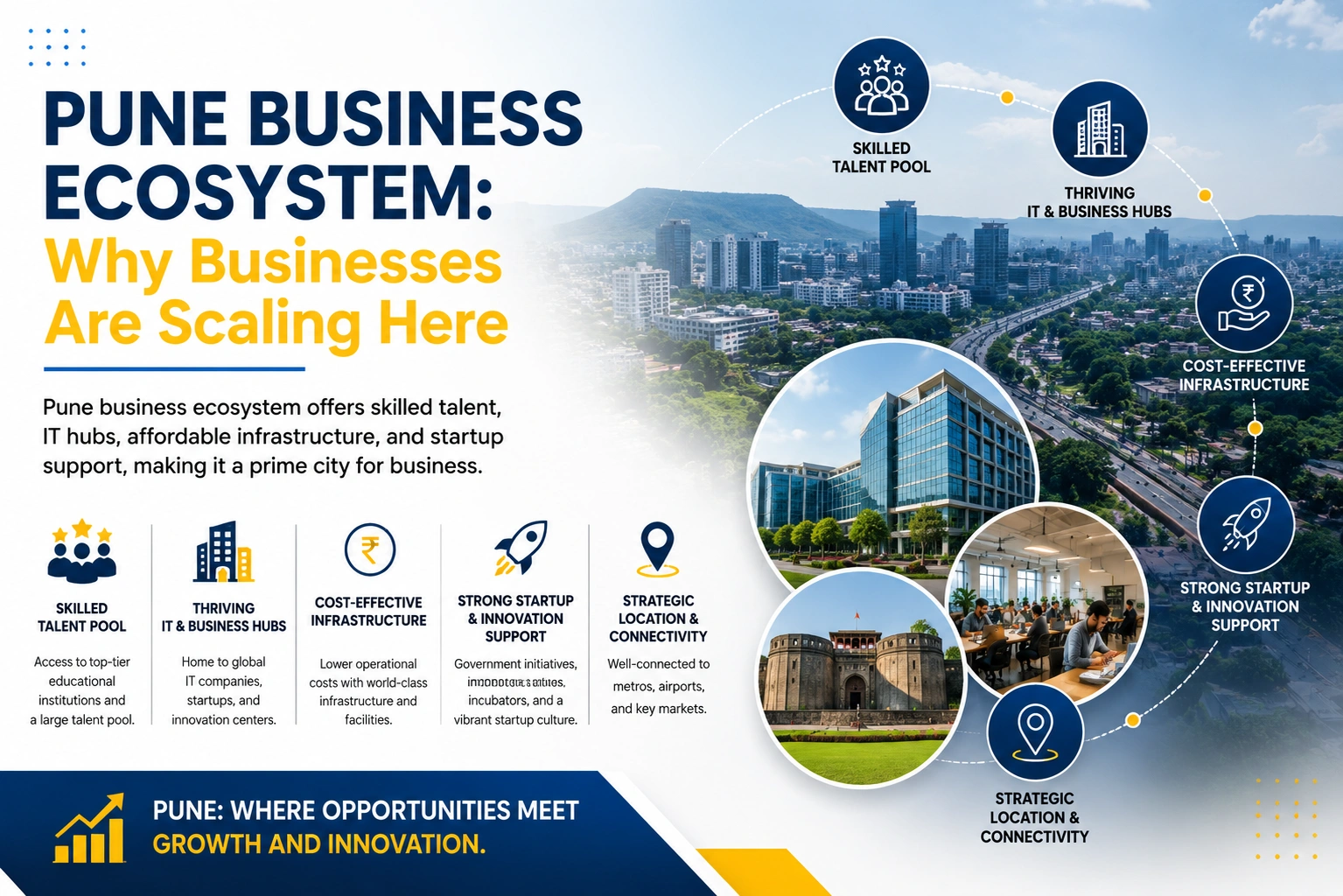
India’s business landscape is undergoing a significant transformation.
For decades, cities like Mumbai, Bengaluru, and Delhi dominated conversations around corporate expansion, startup growth, and global investment. Today, however, a new growth story is emerging, one centered around Pune.
The Pune business ecosystem has emerged as one of India’s most attractive growth destinations. From startups and multinational corporations to Global Capability Centers (GCCs), organizations are increasingly choosing Pune for business expansion due to its strong talent base, competitive operating costs, and rapidly evolving innovation landscape.
Once known primarily as an educational and manufacturing hub, Pune has evolved into one of India’s most dynamic business centers. The city now attracts technology companies, GCCs, research and development centers, and fast-growing enterprises seeking a scalable environment for growth.
The question is no longer whether Pune is growing. The question is why so many businesses are choosing Pune for business expansion and whether this momentum is set to reshape India’s business landscape in the years ahead.
Quick Answer: Why Are Businesses Scaling in Pune?
Businesses are increasingly choosing Pune because it offers:
- Access to a large engineering and technology talent pool
- Lower operational and occupancy costs compared to Mumbai and Bengaluru
- Rapidly growing Global Capability Centers in Pune
- A thriving startup ecosystem
- Strong connectivity to Mumbai and western India
- Expanding commercial infrastructure and managed workspaces
- These factors collectively make Pune one of India’s most strategic growth destinations.
Pune’s Transformation: From Industrial Hub to Innovation Economy
Historically, Pune built its reputation on manufacturing excellence.
Automotive leaders, engineering companies, and industrial enterprises established major operations across the city, creating a strong foundation of technical expertise.
Over the last decade, however, Pune has expanded beyond manufacturing.
Today, the city hosts:
- Technology companies
- SaaS startups
- Fintech firms
- Engineering R&D centers
- AI and analytics teams
- Global Capability Centers
- Shared service centers
This diversification has made the Pune business ecosystem more resilient and attractive to both domestic and international investors.
The Talent Advantage: Pune’s Biggest Growth Engine
Talent remains the single most important factor influencing location decisions.
In this area, Pune holds a significant advantage.
According to a 2026 KPMG report, Pune produces approximately 200,000 graduates annually, including nearly 90,000 STEM graduates. The city has become a major source of engineering, technology, analytics, and research talent.
Why Talent Matters More Than Ever
The global economy is increasingly driven by:
- Artificial Intelligence
- Cloud Computing
- Data Analytics
- Product Engineering
- Cybersecurity
- Automation
Companies need access to skilled professionals in these fields to remain competitive.
Pune’s strong academic ecosystem helps create a continuous pipeline of talent capable of supporting these high-growth sectors.
Benefits for Employers
Organizations expanding in Pune benefit from:
- Faster hiring cycles
- Access to specialized technical talent
- Lower attrition compared to some Tier-1 cities
- Strong engineering capabilities
- Availability of both entry-level and experienced professionals
This talent depth is a major reason why businesses increasingly view Pune for business expansion as a strategic decision rather than merely a cost-saving measure.
Cost Advantage: The Smart Alternative to Mumbai and Bengaluru
Cost optimization remains a critical factor for scaling businesses.
While Mumbai offers unmatched financial connectivity and Bengaluru remains India’s technology capital, both cities face rising operational costs.
Comparison of Key Business Factors
| Factor | Pune | Mumbai | Bengaluru |
| Office Costs | Lower | Highest | High |
| Talent Availability | Strong | Strong | Very Strong |
| Cost of Living | Moderate | Very High | High |
| Commute Complexity | Moderate | High | High |
| Expansion Potential | High | Moderate | Moderate |
| Quality of Life | Strong | Moderate | Strong |
Mumbai’s premium office districts can command rents exceeding ₹450–₹750 per sq. ft. per month, creating substantial occupancy costs for growing companies.
Meanwhile, Pune continues to offer comparatively affordable commercial real estate options while maintaining access to high-quality infrastructure.
This cost efficiency becomes especially valuable for companies scaling from 50 employees to 500 employees or beyond.
The Rise of Global Capability Centers in Pune
One of the strongest indicators of Pune’s growing strategic importance is the rapid expansion of Global Capability Centers in Pune.
GCCs are no longer back-office operations.
Today they drive:
- Product development
- AI innovation
- Engineering
- Research
- Data analytics
- Enterprise transformation
According to KPMG, Pune is now home to more than 500 GCCs representing over 30 countries and 20 industries. The city accounts for approximately 14% of India’s GCC units and 9% of total GCC talent.
Why Global Companies Are Choosing Pune
Several factors are driving GCC growth:
- Deep engineering talent
- Lower operating costs
- Strong digital infrastructure
- Proximity to Mumbai
- Growing innovation ecosystem
The momentum is accelerating.
More than 130 GCCs have entered or expanded in Pune since 2024.
This growth aligns with broader national trends. India’s GCC sector generated nearly $98.4 billion in revenue in FY26 and continues to attract multinational investment.
Pune’s Startup Ecosystem Is Reaching a New Level
Large enterprises are not the only organizations driving growth.
The Pune startup ecosystem is experiencing significant momentum.
According to StartupBlink’s 2026 rankings:
- Pune hosts over 1,200 active startups
- The city ranks among the Top 100 startup cities globally
- Pune is India’s fifth-strongest startup ecosystem
- The ecosystem recorded strong double-digit annual growth.
What’s Driving Startup Growth?
Several factors contribute:
Affordable Scaling
Founders can extend their runway compared to Mumbai or Bengaluru.
Access to Talent
Startups compete more effectively for skilled employees.
Strong Investor Interest
As India’s innovation economy expands, investors increasingly recognize Pune’s potential.
Collaborative Workspaces
The rise of coworking and managed office space in Pune allows startups to scale without long-term lease commitments.
Why Flexible Workspaces Are Becoming Essential
The way businesses scale has changed.
Companies increasingly prefer flexibility over long-term commitments.
As a result, demand for:
- Managed office space in Pune
- Flexible workspace solutions
- Enterprise coworking
- Plug-and-play offices
continues to grow.
For scaling companies, flexible office models provide:
- Faster market entry
- Reduced capital expenditure
- Operational agility
- Easier team expansion
- Access to premium business locations
This trend mirrors broader global workplace transformations where agility has become a competitive advantage.
Global Trends Reinforcing Pune’s Growth
Pune’s rise is not occurring in isolation.
Several global trends are strengthening its position.
1. AI-Driven Talent Demand
GCCs are increasingly hiring AI, cloud, and analytics professionals. GCC hiring growth is now outpacing traditional IT services hiring in India.
2. Enterprise Cost Optimization
Global organizations continue seeking locations that balance capability and efficiency.
3. Distributed Innovation Models
Companies no longer concentrate all operations in a single city.
Instead, they build multi-city talent networks.
4. Engineering-Led Growth
Advanced engineering, R&D, and product development functions are increasingly moving to India, creating opportunities for cities like Pune.
What Does the Future Look Like?
The outlook for Pune remains exceptionally strong.
According to KPMG, Pune’s GCC ecosystem is expected to continue expanding through 2030, supported by policy initiatives, AI-led growth, and increasing multinational investment.
The Maharashtra GCC Policy aims to add hundreds of new centers and create hundreds of thousands of high-skilled jobs, with Pune positioned as a primary beneficiary.
By 2030, India’s GCC landscape is expected to exceed 2,400 centers nationally, generating more than $100 billion in annual value.
Pune is expected to capture a meaningful share of this growth.
Why Businesses Are Choosing Sprint India for Workspace Solutions in Pune
As more companies choose Pune for business expansion, the need for flexible, scalable, and strategically located workspaces continues to grow. Whether it’s a startup building its first team, a GCC establishing a satellite office, or an enterprise expanding into new markets, workspace decisions increasingly influence talent acquisition, operational efficiency, and business agility.
This is where Sprint India‘s Pune footprint creates a distinct advantage.
With a presence across Pune’s most active business corridors, including Baner, Hinjewadi, Kharadi, Viman Nagar, Mundhwa, and Wakadewadi, Sprint enables businesses to establish operations closer to talent pools, clients, and key commercial districts. Sprint India currently operates eight centers across Pune, offering one of the city’s most extensive managed workspace networks.
Strategic Locations Across Pune’s Growth Corridors
Sprint’s Pune portfolio includes locations in:
- Baner – A thriving startup and technology hub
- Hinjewadi – Pune’s largest IT and technology district
- Kharadi – One of the fastest-growing corporate and GCC destinations
- Viman Nagar – A well-connected commercial and business zone
- Mundhwa – An emerging mixed-use business district
- Wakadewadi – Close to Pune’s central business and administrative areas
These locations place businesses at the heart of Pune’s most dynamic commercial ecosystems, helping reduce commute times while improving access to talent and clients.
Flexible Workspace Solutions for Every Growth Stage
Businesses scale differently, and workspace requirements evolve over time.
Sprint offers:
- Managed office spaces
- Service Suits
- Enterprise workspace solutions
- Meeting and conference rooms
- Fully serviced office environments
This flexibility allows organizations to expand without the capital expenditure and long-term commitments associated with traditional office leasing.
Designed for Modern Businesses
Beyond physical infrastructure, modern organizations seek workspaces that support productivity, collaboration, and employee experience.
Sprint workspaces are designed with:
- Plug-and-play infrastructure
- High-speed internet connectivity
- 24/7 access
- Collaboration zones
- Meeting facilities
- Professional support teams
- Business-ready amenities
This enables companies to focus on growth while Sprint Indiamanages day-to-day workplace operations.
Supporting Pune’s Next Generation of Growth
As Pune continues to attract startups, technology companies, GCCs, and expanding enterprises, workspace flexibility will become increasingly important.
By combining strategic locations, scalable office solutions, and operational convenience, Sprint India is helping businesses establish, expand, and succeed within Pune’s rapidly evolving business landscape.
Conclusion
The rise of Pune is not a temporary trend.
It reflects a deeper shift in how businesses evaluate growth, talent, cost efficiency, and long-term scalability.
The combination of a strong talent pipeline, competitive operating costs, a rapidly expanding startup ecosystem, and accelerating GCC investment has transformed the Pune business ecosystem into one of India’s most strategic growth destinations.
For organizations evaluating their next phase of expansion, Pune offers something increasingly difficult to find elsewhere: the ability to scale efficiently without compromising access to talent, innovation, or opportunity.
As India’s economic geography continues to evolve, Pune is no longer simply an alternative to larger cities.
It is becoming one of the primary destinations for Pune for business expansion in the decade ahead.
FAQs
1. Why is Pune becoming a preferred city for business expansion in India?
Pune offers a unique combination of skilled talent, lower operating costs compared to Mumbai and Bengaluru, strong infrastructure, a growing startup ecosystem, and rapid expansion of Global Capability Centers (GCCs). These factors make Pune an attractive destination for businesses looking to scale efficiently.
2. How does Pune compare with Mumbai and Bengaluru for business growth?
While Mumbai remains India’s financial capital and Bengaluru continues to lead in technology, Pune offers a more balanced value proposition. Companies benefit from access to high-quality talent, lower office costs, reduced operational expenses, and a strong quality of life, making it an increasingly strategic destination for expansion.
3. Which business locations in Pune are experiencing the highest growth?
Kharadi, Hinjewadi, Baner, Viman Nagar, Mundhwa, and Wakadewadi are among Pune’s fastest-growing commercial districts. These locations attract startups, IT companies, GCCs, and multinational enterprises due to their connectivity, infrastructure, and talent accessibility.
4. Why are flexible and managed office spaces gaining popularity in Pune?
Businesses increasingly prefer flexible workspaces because they reduce upfront investment, enable faster expansion, provide operational flexibility, and allow organizations to scale according to business needs without being locked into long-term leases.
5. How can Sprint India support companies expanding in Pune?
Sprint India offers managed office spaces, private offices, coworking spaces, dedicated desks, meeting rooms, and enterprise workspace solutions across Pune’s key business districts. With multiple locations and flexible workspace models, Sprint helps businesses establish and scale operations efficiently while focusing on growth.
SOURCES:
GCC Growth
KPMG India (2026)
https://kpmg.com/in/en/insights/2026/06/pune-a-strong-growth-frontier-for-global-capability-centers-in-india.html
India GCC Market
Pune Startup Ecosystem
StartupBlink
https://www.startupblink.com/startup-ecosystem/pune-in
Maharashtra GCC Policy
The Times of India
https://timesofindia.indiatimes.com/city/pune/pune-leads-in-gcc-investment-with-400-units-planned-in-state/articleshow/129174521.cms
GCC Hiring Growth