
Expanding to PAN India? Here’s How to Pick the Right Office Setup
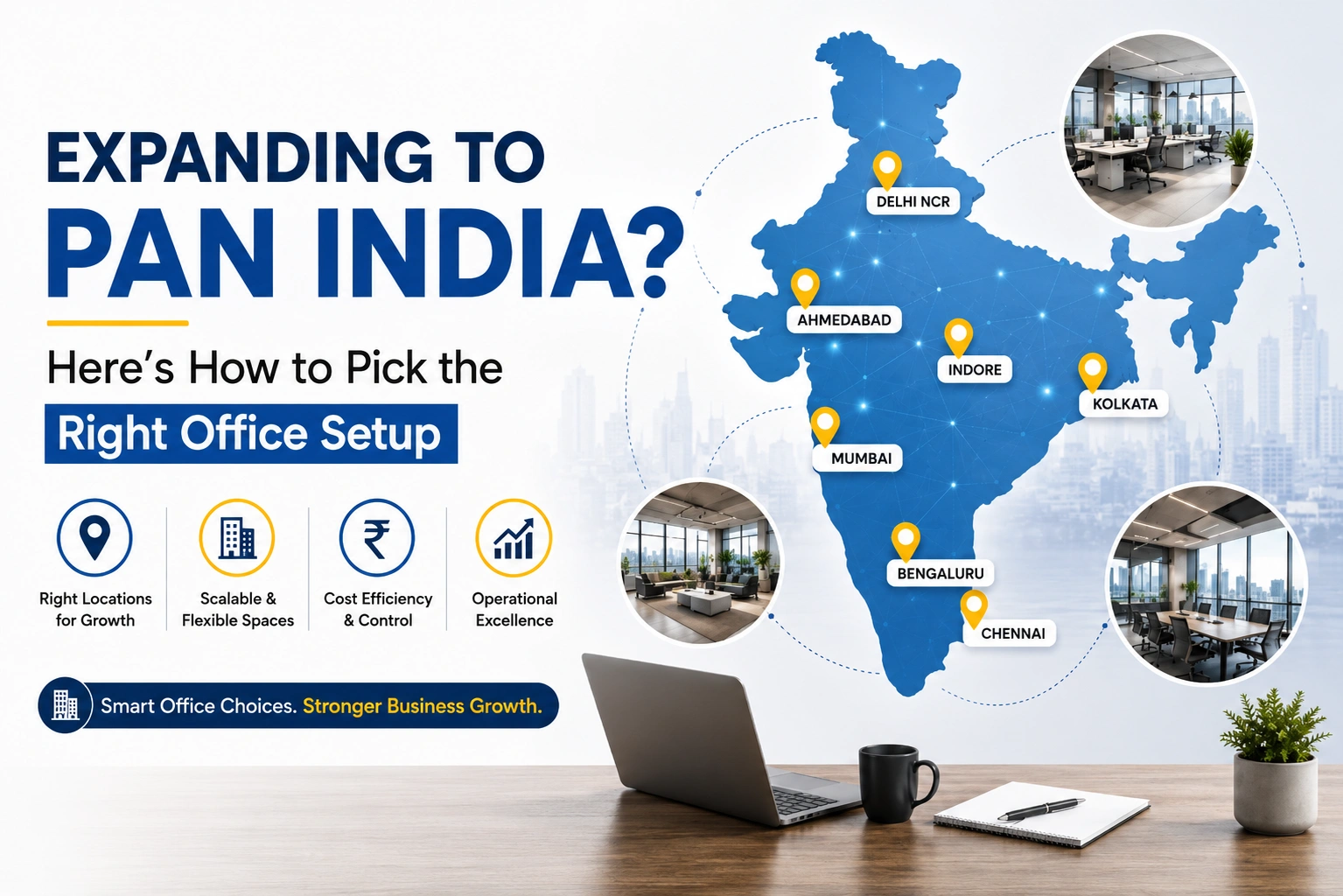
A practical guide to office space for business expansion in India
If you’re evaluating office space for business expansion in India, you’re entering the market at an interesting time. India’s office sector just posted its strongest-ever quarter, with businesses leasing a record around 24.6 million square feet in Q2 2026 alone, driven by strong demand from flexible workspace operators and Global Capability Centres.
If you’re a founder, HR head, or operations leader trying to open offices in multiple cities without the delays, capex, and compliance headaches of a traditional lease, this guide breaks down exactly how to choose the right setup, city by city.
Why PAN India Expansion Is Happening Right Now
Three forces are pushing companies to open offices across multiple Indian cities simultaneously, instead of picking just one headquarters city.
- Talent is spreading out. Tier-1 salaries and real estate costs have pushed companies to hire in Pune, Hyderabad, Ahmedabad, and Kolkata, not just Bengaluru and Mumbai.
- GCCs are scaling fast. Global Capability Centres accounted for 42% of India’s total office absorption in Q2 2026, the highest-ever quarterly share on record, and many are setting up in multiple cities from day one.
- Flex space has matured. India’s flexible office stock crossed 110–114 million square feet in 2025, roughly three times what it was in 2020, growing at a 23–25% CAGR, with over 500 operators running approximately 2,600 centres nationwide.
Quick snapshot:
| Metric | Figure |
| India office leasing, Q2 2026 | ~24.6 million sq. ft. (all-time high) |
| H1 2026 leasing | ~45.5 million sq. ft., highest ever for six months |
| Flex space share of Q2 2026 leasing | 27% |
| India’s total flex stock (2025) | 110–114 million sq. ft. |
| Flex stock CAGR (2020–2025) | 23–25% |
The takeaway: flex and managed offices aren’t a stopgap anymore. In 2025, 55–60% of total flex demand came from global companies making deliberate, long-term real estate decisions, not just startups looking to cut costs.
Traditional Lease vs. Managed Office vs. Coworking Space: What’s the Difference?
Before you pick a city, pick a model. This decision affects your budget, your timeline, and how much control you have over the space.
| Factor | Traditional Lease | Managed Office | Shared / Coworking Space |
| Setup time | 4–9 months | 2–6 weeks | 1–2 weeks |
| Upfront capex | High (fit-out, furniture, IT) | Low to none | Minimal |
| Contract length | 3–9 years | 1–3 years | Monthly to yearly |
| Branding & customisation | Full control | High (private, branded floor) | Limited |
| IT, facility, security | You manage it | Provider manages it | Provider manages it |
| Best for | Large HQ, 10+ year commitment | Regional offices, GCCs, scaling teams | Freelancers, small teams, pilot cities |
Managed offices sit in the sweet spot for PAN India expansion. You get a private, fully branded floor with your own access control, but the provider owns the fit-out, furniture, networking, housekeeping, and facility management under one monthly invoice. Fit-out, facility management, IT, utilities, and security consolidate into one fee, with lease terms typically running one to three years, a fraction of the risk of a conventional 9-year lease.
How to Choose the Right City-Wise Setup
Not every city needs the same footprint. Here’s a practical way to think about it.
1. Match the space type to the office’s role
- HQ or largest team → Managed office (branding, security, and control matter more here)
- New market entry/test city → Coworking or a smaller managed suite (low commitment while you validate demand)
- Client-facing regional office → Managed office or service suite (impression matters)
- Sales or support pod (5–20 people) → Coworking with a private cabin
2. Check local market depth before you commit
Bengaluru, Pune, and Ahmedabad together contributed 73% of India’s Q2 2026 office supply, so these cities currently have the most inventory to choose from. Delhi-NCR recorded its highest-ever quarterly flex office take-up in Q2 2026, with flex operators accounting for 45% of the region’s total leasing — up from just 0.3 million sq. ft. a year earlier, meaning NCR occupiers are increasingly flex-first by default.
For large teams, also check where enterprise-scale deals are landing: Bengaluru, Hyderabad, and Pune together made up 68% of all large-format office transactions in Q2 2026, making them the strongest picks for a major regional hub rather than a small satellite office.
More supply = more choice and better negotiating power
More absorption = book early before good space fills up
More flex-specific leasing = easier to justify a managed office over a traditional lease.
3. Look at what’s driving demand in each city — it tells you what’s available
| City | What’s driving office demand | What it means for you |
| Pune | Record leasing of ~4.1 million sq. ft. in Q2 2026, led by flex operators at 38% of demand | Wide flex inventory, strong tech and manufacturing talent base |
| Hyderabad | Among the top three cities for large-format transactions along with Bengaluru and Pune | Strong GCC and IT presence, competitive rents |
| Mumbai | Among the top three contributors to H1 2026 national absorption | Premium micro-markets, higher cost, strong for client-facing offices |
| Noida / Delhi-NCR | Regional flex leasing rose from 0.3 million sq. ft. in Q2 2025 to 1.6 million sq. ft. in Q2 2026 | Fastest-growing flex adoption region in the country right now |
| Ahmedabad | One of the top three cities contributing to national office supply | Emerging hub, cost-effective, growing GCC interest |
| Kolkata | Emerging market for flex operators expanding beyond metro cities | Lower cost base, good for back-office and support functions |
4. Don’t ignore the “flight to quality” trend
Occupiers today aren’t just chasing the cheapest desk. Demand is moving decisively towards premium, highly amenitised spaces that enhance brand presence and employee experience, a shift away from pure price-sensitivity. If your office is client-facing or you’re trying to attract talent back to in-person work, factor design and amenities into your city-wise budget, not just rent per seat.
A Simple Checklist Before You Sign
- Is the location within 20–30 minutes of your key talent pool or client cluster?
- Does the provider offer plug-and-play setup, or will you need your own IT and furniture vendor?
- Can the contract flex up or down as your headcount changes?
- Is there a single point of contact for facility, IT, and admin issues across all cities?
- Are meeting rooms, branding rights, and 24/7 access included, or billed separately?
- Does the provider already operate in the cities on your expansion roadmap, so you get one vendor relationship instead of seven?
Why a Single Managed Office Partner Works Better for Multi-City Expansion
Running a PAN India expansion through seven different local landlords or coworking brands means seven different contracts, seven different support teams, and seven different billing cycles. A single provider with a presence across your target cities removes that friction.
This is where Sprint India fits in. Sprint operates plug-and-play managed offices, service suites, coworking spaces, and meeting rooms across the exact cities most companies are expanding into right now:
- Pune — eight locations including Baner, Kharadi, Viman Nagar, and Hinjewadi
- Mumbai — Kurla (LBS Road)
- Hyderabad — Hi-Tech City and Gachibowli
- Noida — Sector 62 (multiple towers)
- Delhi — Sarita Vihar
- Ahmedabad — Satellite Road and Bodakdev
- Kolkata — Sector V, Bidhannagar
Every location is built around the same principle: fully furnished, IT-ready, branded office space that a team can move into and start working from on day one. No fit-out timeline, no separate vendors for furniture, networking, or facility management. For a business opening its third or fourth city, that consistency across locations is often more valuable than a marginally cheaper rate in any single city.
If you’re structuring a hybrid footprint, a managed office as your anchor city and coworking desks in secondary cities, a provider like Sprint that offers all four space types (managed offices, service suites, coworking, meeting rooms) under one roof lets you mix and match by city without switching vendors.
The Bottom Line
Choosing the right office setup for a PAN India expansion isn’t about picking the cheapest desk in each city. It’s about matching the space type to the office’s role, understanding which cities currently have the deepest and fastest-growing flex inventory, and consolidating your footprint under a provider that can move with you from city to city without renegotiating everything from scratch.
With H1 2026 already marking the strongest six-month leasing period on record, the market is moving fast; the businesses that lock in the right cities and the right setup now will have first pick of the best-located, best-managed spaces.
Frequently Asked Questions
What is a managed office space?
A managed office is a private, fully furnished workspace where the provider handles fit-out, furniture, IT infrastructure, facility management, and security under a single monthly fee. You control the branding and layout without the capex or setup time of a traditional lease.
Is a managed office cheaper than a traditional lease?
Usually yes on upfront cost, since fit-out, furniture, and infrastructure are bundled into the provider’s fee instead of being a separate capital expense. Traditional leases can also lock you in for 3–9 years, while managed offices typically run 1–3 years, reducing long-term risk if your headcount changes.
Which Indian cities are best for managed office expansion in 2026?
Bengaluru, Pune, and Delhi-NCR together accounted for 58% of India’s Q2 2026 office absorption, making them the deepest markets right now. Hyderabad and Ahmedabad are close behind on supply growth, while Noida and Kolkata are seeing the fastest year-on-year jump in flex adoption.
How long does it take to set up a managed office compared to a traditional lease?
A managed office can typically be operational in 2–6 weeks, compared to 4–9 months for a traditional lease that requires fit-out, furniture procurement, and IT setup from scratch.
What’s the difference between coworking and a managed office?
Coworking spaces are shared environments with hot desks or private cabins, best for small teams or short-term needs. Managed offices are private, branded floors dedicated to one company, better suited for larger or longer-term teams that need more control and consistency.
Why are companies choosing flexible/managed offices over traditional leases in 2026?
In 2025, more than half of total flex demand came from global companies making deliberate, long-term real estate allocations; flex is no longer just a cost play for early-stage startups. Businesses are using it for faster market entry, lower upfront risk, and the ability to scale office footprints up or down as headcount changes.
Does Sprint India offer managed offices in multiple cities?
Yes. Sprint India operates managed offices, service suites, coworking spaces, and meeting rooms across Pune, Mumbai, Hyderabad, Noida, Delhi, Ahmedabad, and Kolkata, letting businesses expand PAN India through a single provider relationship.
Sources
- CBRE South Asia, India Office Figures Q2 2026 — via ANI/BizzBuzz News, bizzbuzz.news
- CBRE South Asia, Delhi-NCR flex office data, Q2 2026 — via ANI, aninews.in
- Business Standard, India’s office mkt posts record quarterly leasing on GCC, flex demand: CBRE, business-standard.com
- Big News Network, India’s office leasing hits record 24.6 million sq ft in Q2, bignewsnetwork.com
- FICCI–CBRE, ‘Flex-plosion’: India’s Flexible Workspaces Era, ficci.in and cbre.co.in
- Tablespace, India Flex Office Market Triples: Managed Office Growth, tablespace.com
- Punekar News, Pune reports its all-time-high quarterly office leasing in Q2 2026, punekarnews.in
- CBRE India, Pune’s office stock expected to rise ~49% to ~140 million sq. ft. by 2030, cbre.co.in
- Sprint India — sprintindia.work and sprintindia.work/our-location