
How AI Is Redefining the Modern Office and the Future of Work
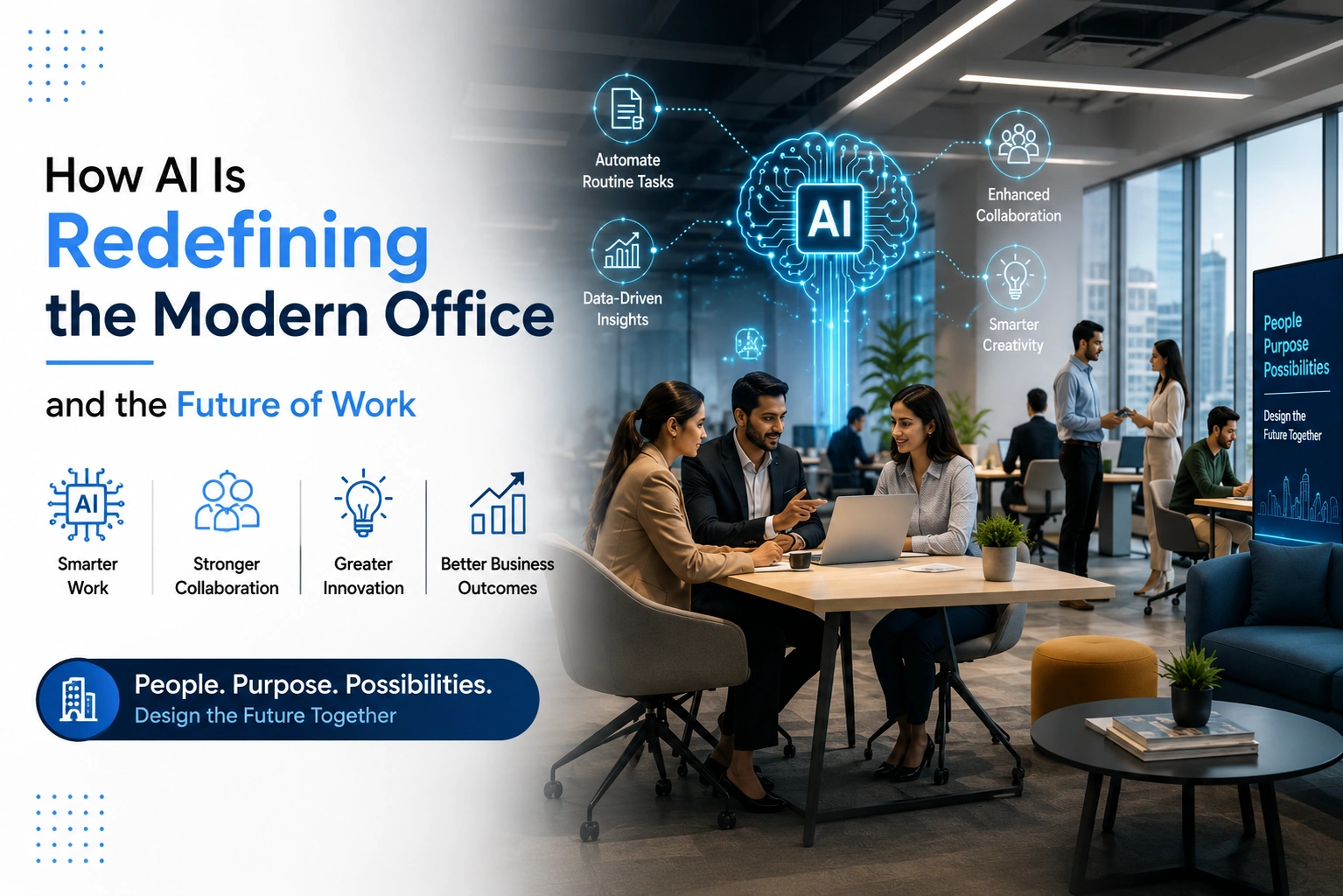
Artificial intelligence (AI) has moved beyond being a futuristic concept. Today, it is embedded into everyday work such as drafting emails, summarizing meetings, analyzing data, generating code, automating workflows, and supporting business decisions. As AI becomes a part of daily operations across industries, organizations are beginning to ask a bigger question:
If AI changes how people work, what does it mean for the workplace itself?
For years, discussions around the future of work focused on remote work, hybrid models and digital collaboration. Many predicted that as technology advanced, the need for physical offices would steadily decline.
However, the rise of AI is telling a different story.
Instead of making offices obsolete, AI is redefining their purpose. As routine and repetitive tasks become increasingly automated, the value of human collaboration, creativity, critical thinking, and relationship-building continues to grow. The office is no longer simply a place where employees work; it is becoming the place where people innovate, solve complex challenges, build culture, and create business value together.
This shift is prompting organizations to rethink not just where employees work, but why they come to the office in the first place.
What Is an AI-Powered Workplace?
An AI-powered workplace is an environment where artificial intelligence supports employees by automating routine tasks, improving decision-making, enhancing productivity, and enabling better collaboration. Rather than replacing employees, AI enables people to focus on work that requires creativity, strategic thinking, problem-solving, and human interaction.
Unlike previous waves of workplace technology, AI doesn’t simply make existing processes faster; it changes how work is distributed between people and machines.
Today, AI is being used to:
- Generate reports and presentations
- Summarize meetings and action points
- Assist with coding and software development
- Analyze large volumes of business data
- Automate customer support interactions
- Improve project planning and workflow management
- Enhance workplace collaboration through intelligent assistants
According to the Microsoft 2025 Work Trend Index, 82% of business leaders believe this is a pivotal year to rethink key aspects of strategy and operations with AI, highlighting how rapidly organizations are integrating AI into their business models.
Key TakeawayAI is not replacing the workplace. It is changing the type of work people perform within it. |
How AI Is Reshaping the Future of Work
Every major technological shift has changed the nature of work. Industrial automation transformed manufacturing. The internet reshaped communication. Cloud computing enabled global collaboration.
AI is now reshaping knowledge work.
Instead of eliminating jobs wholesale, AI is automating tasks that are repetitive, rules-based, and data-intensive. This allows employees to dedicate more time to higher-value activities where human judgment and creativity remain essential.
Across industries, professionals are already using AI to:
- Reduce time spent on administrative work
- Generate first drafts of documents and proposals
- Analyze customer insights
- Support financial forecasting
- Improve software development
- Streamline HR processes
- Enhance marketing campaigns
- Accelerate research and innovation
This shift is changing how organizations define productivity.
Success is becoming less about the number of hours worked and more about the quality of ideas, faster decision-making, innovation, and business outcomes.
The World Economic Forum’s Future of Jobs Report 2025 estimates that 39% of workers’ core skills are expected to change by 2030, driven largely by AI, automation, and digital transformation. Continuous learning and adaptability are becoming business-critical capabilities rather than optional skills.
Why the Modern Office Matters More in the AI Era
One of the biggest misconceptions surrounding AI is that smarter technology automatically reduces the need for physical offices.
In reality, the opposite is happening.
If AI enables employees to complete routine tasks from virtually anywhere, then organizations need a stronger reason to bring people together.
The office is no longer the default location for individual work—it is becoming the preferred environment for collaboration.
Modern organizations increasingly use office spaces for activities such as:
- Strategic planning
- Cross-functional collaboration
- Innovation workshops
- Product development
- Client engagement
- Leadership meetings
- Mentorship and coaching
- Learning and knowledge sharing
These activities rely on trust, communication, creativity, and spontaneous interaction—qualities that AI can support but not replace.
Research from Gensler’s Global Workplace Survey consistently shows that employees place the highest value on offices that enable collaboration, team connections, learning, and innovation rather than simply providing desks to work from.
Key InsightAs AI handles routine work, offices become more valuable as spaces where people create ideas, solve problems, and strengthen relationships. |
From Assigned Desks to Purpose-Driven Workspaces
Traditional offices were designed around permanence.
Employees had assigned desks, fixed departments, and predictable workflows. Office layouts reflected organizational hierarchies rather than collaboration.
The AI era demands something different.
Business priorities evolve rapidly. Teams form around projects rather than departments. Employees alternate between focused work, virtual collaboration, brainstorming sessions, client meetings, and innovation workshops.
As a result, workplaces are being redesigned around flexibility rather than fixed infrastructure.
Organizations increasingly prioritize:
- Collaboration zones
- Focus rooms
- Technology-enabled meeting spaces
- Informal breakout areas
- Wellness spaces
- Community-driven environments
- Smart workplace technologies
The office is no longer measured by occupancy.
It is measured by how effectively it enables people to work together.
Why AI Is Fueling Demand for Flexible and Managed Offices
AI-driven businesses rarely grow in a straight line.
A startup may double its workforce within months after securing funding. A product team may expand rapidly while another project concludes. Enterprises launching AI initiatives often establish dedicated innovation teams before scaling across multiple locations.
This uncertainty makes long-term office planning increasingly challenging.
Traditional office leases often require significant upfront investment, fixed seating capacities, and long contractual commitments.
Flexible workspaces and managed office solutions offer a more agile alternative.
They enable businesses to:
- Scale teams quickly
- Expand into new cities
- Reduce capital expenditure
- Avoid lengthy office setup timelines
- Adapt to changing workforce requirements
- Access enterprise-grade workplace infrastructure without operational complexity
Industry analysts increasingly recognize flexibility as a strategic business advantage rather than simply a real estate trend.
According to Redseer Strategy Consultants, AI-driven businesses are expected to contribute significantly to the growing demand for flexible workspaces in India, as organizations prioritize agility, scalability, and faster expansion over traditional office models.
Similarly, JLL’s Future of Work research highlights that organizations are increasingly investing in workplace experiences that support collaboration, employee engagement, and business adaptability instead of simply expanding office footprints.
Beyond Flexibility: Building Workplaces That Enable Innovation
The conversation around offices is shifting.
Organizations are no longer asking,
“How much office space do we need?”
Instead, they are asking,
“What kind of workplace helps our people perform at their best?”
This subtle shift changes everything.
Businesses are now evaluating workplaces based on their ability to support:
- Faster decision-making
- Team collaboration
- Employee engagement
- Innovation
- Talent attraction and retention
- Client experience
- Business continuity
- Operational scalability
In the AI era, the workplace becomes part of the organization’s competitive advantage rather than simply an operational expense.
What Makes an Office AI-Ready?
An AI-ready office isn’t defined by advanced technology alone.
It is designed to help people and technology work together seamlessly.
An AI-ready workplace typically includes:
Technology-Enabled Collaboration
Smart meeting rooms, high-speed connectivity, intelligent scheduling systems, and seamless hybrid collaboration tools ensure teams can work effectively regardless of location.
Flexible Infrastructure
Businesses need office environments that can scale alongside workforce growth without disrupting operations.
Employee-Centric Design
Spaces that support focused work, collaboration, learning, and wellbeing improve both employee experience and productivity.
Data-Driven Workplace Management
AI-powered workplace analytics help organizations optimize space utilization, energy consumption, meeting room usage, and operational efficiency.
Agility
Perhaps the most important characteristic of an AI-ready workplace is its ability to adapt.
As AI continues to evolve, workplaces must evolve alongside changing business models, workforce expectations, and organizational priorities.
Sprint India’s Perspective: Building Workspaces for the Future of Work
Artificial intelligence is changing how businesses operate, but it is also changing what organizations expect from their workplaces.
Today’s businesses need more than office space; they need environments that can keep pace with evolving teams, shifting business priorities, and rapid growth. Whether it’s an AI startup scaling after a funding round, a Global Capability Centre (GCC) expanding its operations, or an enterprise launching a new business unit, workplace agility has become a strategic advantage.
This is where the role of flexible workspaces is evolving.
At Sprint India, we see the modern office as more than a place to work. It is an ecosystem designed to support collaboration, innovation, and business continuity. As organizations increasingly automate routine tasks with AI, the value of bringing people together for strategic discussions, problem-solving, mentorship, and client engagement continues to grow.
Our coworking spaces, managed offices, and plug-and-play office solutions are built around this new reality. Instead of investing time and capital in setting up conventional offices, businesses can move into fully managed workspaces that are ready from day one and flexible enough to grow alongside their operations.
For organizations navigating the future of work, flexibility is no longer just a convenience but is a business necessity. The ability to expand teams, establish a presence in new markets, or adapt workspace requirements without operational disruption enables businesses to respond more quickly to changing opportunities.
As AI continues to reshape industries, workplaces will play a greater role in enabling collaboration, strengthening company culture, and supporting innovation. Sprint India is committed to creating workspaces that help businesses stay agile, productive, and future-ready.
Key Takeaways
AI is transforming the future of work, but it isn’t replacing the office. Instead, it is redefining its purpose.
- AI is automating repetitive tasks, allowing employees to focus on creativity, strategy, and collaboration.
- The modern office is evolving into a destination for innovation, learning, mentorship, and relationship-building rather than routine desk work.
- Flexible workspaces and managed offices help businesses adapt quickly to changing workforce requirements.
- AI-ready workplaces combine technology, adaptability, and employee-centric design to support modern ways of working.
- Organizations that invest in agile workspaces today will be better positioned to thrive in the future of work.
Conclusion: The Office Has a New Purpose
The conversation around AI has evolved from whether it will change the workplace to how businesses can adapt to the changes it brings. While AI is transforming the way work gets done, it is also reinforcing the importance of what only people can do—collaborate, innovate, build relationships, and make strategic decisions.
This shift is redefining the role of the modern office. No longer just a place for routine tasks, today’s workplace is becoming a hub for creativity, knowledge sharing, culture, and business growth. Organizations are beginning to prioritize spaces that encourage meaningful interactions, support hybrid teams, and provide the flexibility to adapt as business needs evolve.
As companies continue to invest in AI, the workplaces that succeed will be those designed around people as much as around technology. The future of work isn’t about choosing between AI and the office, but about creating environments where both work together to unlock greater productivity, innovation, and long-term success.
For businesses navigating this transformation, flexible and future-ready workspaces are becoming a strategic advantage. By combining operational agility with collaborative environments, Sprint India helps organizations build workplaces that are equipped not only for today’s business needs but also for the opportunities of tomorrow.
The future of work is already here. The question is no longer whether the office will evolve; it’s how well your workplace is prepared for what’s next.
FAQs on AI and the future of work
1. How is AI changing the future of work?
AI is transforming the future of work by automating repetitive tasks, improving decision-making, and increasing productivity. This enables employees to spend more time on creative thinking, collaboration, innovation, and solving complex business challenges.
2. Why is AI redefining the modern office?
As AI handles routine work, employees increasingly visit the office for activities that benefit from human interaction, such as brainstorming, strategic planning, mentorship, client meetings, and team collaboration. The office is evolving from a place of routine work into a hub for innovation and culture.
3. Will AI replace physical offices?
No. While AI supports remote productivity, it also increases the importance of offices as spaces where teams collaborate, build relationships, and drive innovation. The purpose of the office is changing rather than disappearing.
4. What is an AI-powered workplace?
An AI-powered workplace integrates artificial intelligence into daily operations to automate repetitive tasks, improve workflows, support decision-making, and enhance employee productivity. It allows people to focus on higher-value work that requires creativity and critical thinking.
5. Why are flexible workspaces becoming more popular?
Flexible workspaces enable businesses to scale operations, expand into new markets, reduce upfront infrastructure costs, and adapt quickly to changing workforce requirements. This makes them particularly valuable for startups, enterprises, and rapidly growing organizations.
6. What is a plug-and-play office?
A plug-and-play office is a fully furnished, ready-to-use workspace equipped with essential business infrastructure, including internet connectivity, meeting rooms, utilities, and administrative support. Businesses can move in and begin operations immediately without investing in an office setup.
7. How do managed office spaces support business growth?
Managed office spaces remove the burden of office administration, allowing organizations to focus on business operations while benefiting from scalable infrastructure, professional facilities, and flexible expansion options.
8. What features define an AI-ready office?
An AI-ready office typically includes smart workplace technologies, collaborative meeting spaces, high-speed connectivity, flexible layouts, workplace analytics, and infrastructure that supports both in-office and hybrid teams.
9. Why is workplace flexibility important in the AI era?
AI-driven businesses often experience rapid growth and evolving workforce needs. Flexible workplaces allow organizations to respond quickly by scaling office space, supporting project-based teams, and adapting to changing business priorities without long-term real estate constraints.
10. How is Sprint India supporting the future of work?
Sprint India provides coworking spaces, managed offices, and plug-and-play workspaces designed to help businesses adapt to changing workforce needs. By offering flexible, fully managed office solutions, Sprint India enables organizations to focus on innovation, collaboration, and sustainable growth in an AI-driven business environment.
Source
Microsoft – The Future of Jobs Report 2025
The Future of Jobs Report 2025
Gensler’s 2026 Global Workplace Survey